
RomeoSEO12 min read
AI Search Optimization Tools: How to Compare Them
Compare AI search optimization tools for SEO automation and AI-search visibility, with practical criteria for evidence, review, workflow, and cost.
AI search optimization tools are not one neat product category. The phrase can refer to tools that automate traditional SEO work, tools that help content appear in AI-generated answers, or platforms that combine both kinds of visibility work.
That distinction should shape your evaluation. If your problem is finding ranking opportunities, refreshing pages, or preparing technical and content changes, you are comparing SEO workflow tools. If your problem is understanding whether AI-generated answers mention, describe, or cite your business, you need an AI-search visibility workflow. Some teams may need both, but they should not assume that a tool built for one job measures the other.
The best choice is the tool that connects reliable evidence to a reviewable decision. It should help you understand what to change, why the change matters, and how a person can approve or reject it before publication.
What are AI search optimization tools?
AI search optimization tools use machine learning or generative AI to assist with search research, analysis, recommendations, content production, or implementation. Depending on the product, that may include:
- Finding keyword and page-level opportunities
- Monitoring rankings or Search Console data
- Auditing existing content
- Suggesting titles, metadata, internal links, or content improvements
- Identifying possible keyword cannibalization
- Preparing changes for a pull request or CMS draft
- Measuring visibility in AI-generated search answers
These capabilities are different from one another. A writing assistant may produce a draft but have little understanding of your existing site. A rank-monitoring tool may show movement without explaining which page should change. An AI-search visibility tool may answer questions about mentions or citations without helping you implement an SEO fix.
Before comparing products, define the search experience you want to improve and the decision the tool must support.
Traditional SEO automation versus AI-search visibility
“AI search” is often used in two related but distinct ways.
Traditional SEO automation helps improve performance in conventional search results. Typical work includes finding opportunities, auditing pages, improving content, checking internal links, monitoring rankings, and preparing changes for review. The evidence may include ranking history, Search Console data, the current page, related queries, and the structure of the existing site.
AI-search visibility focuses on generative search experiences. The questions are different: Does an AI-generated answer mention the brand? Which sources does it use? How is the company described? Does the answer appear accurate and useful? Those questions require a measurement method designed for AI-generated results rather than an assumption that ordinary rank tracking is a substitute.
A tool should state which of these jobs it supports. Do not assume that every product described as an “AI SEO tool” measures visibility in AI answers. Likewise, do not assume that a platform that monitors AI answers can audit your content or deliver an approved site change.
A simple starting decision is:
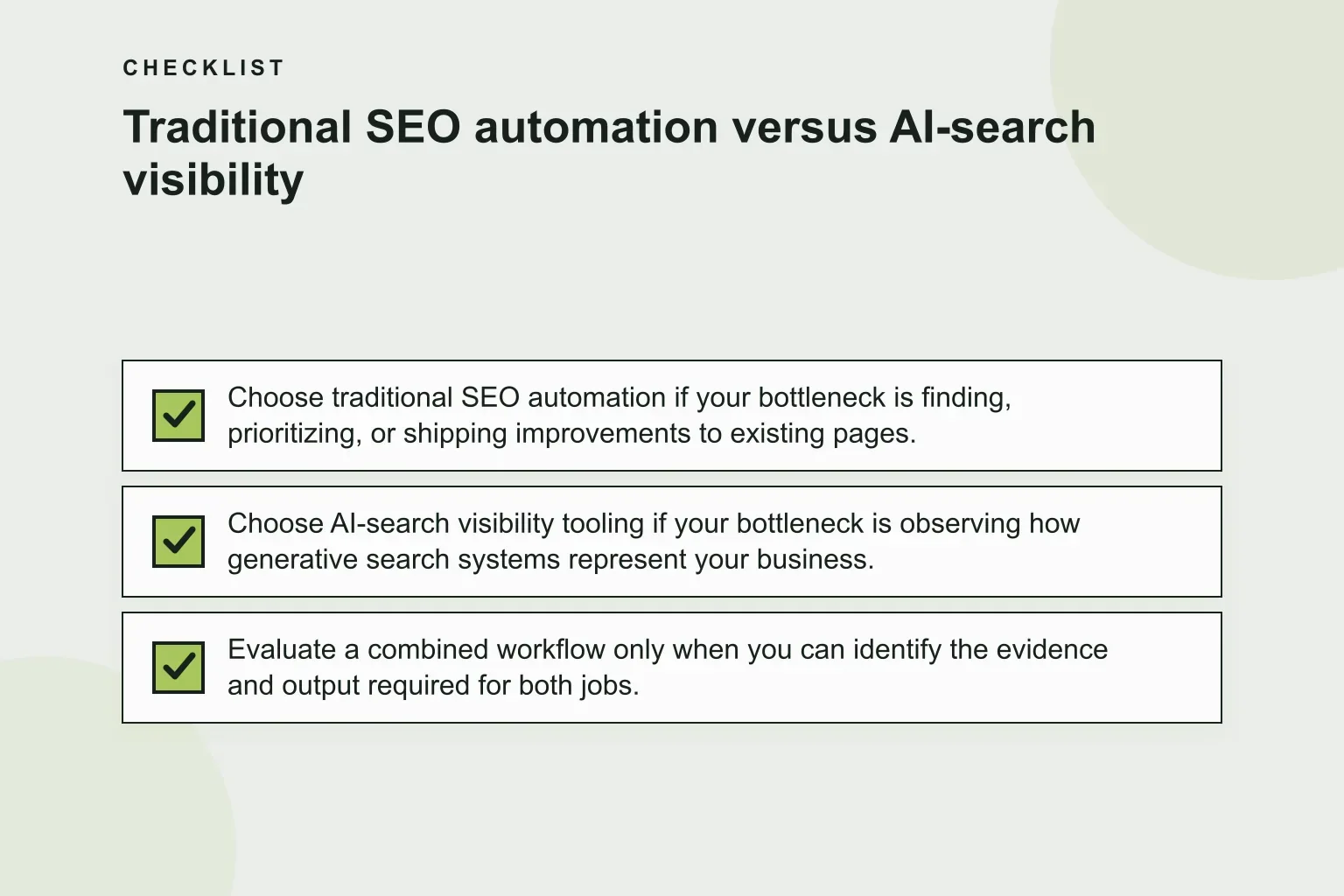
- Choose traditional SEO automation if your bottleneck is finding, prioritizing, or shipping improvements to existing pages.
- Choose AI-search visibility tooling if your bottleneck is observing how generative search systems represent your business.
- Evaluate a combined workflow only when you can identify the evidence and output required for both jobs.
The main categories to compare
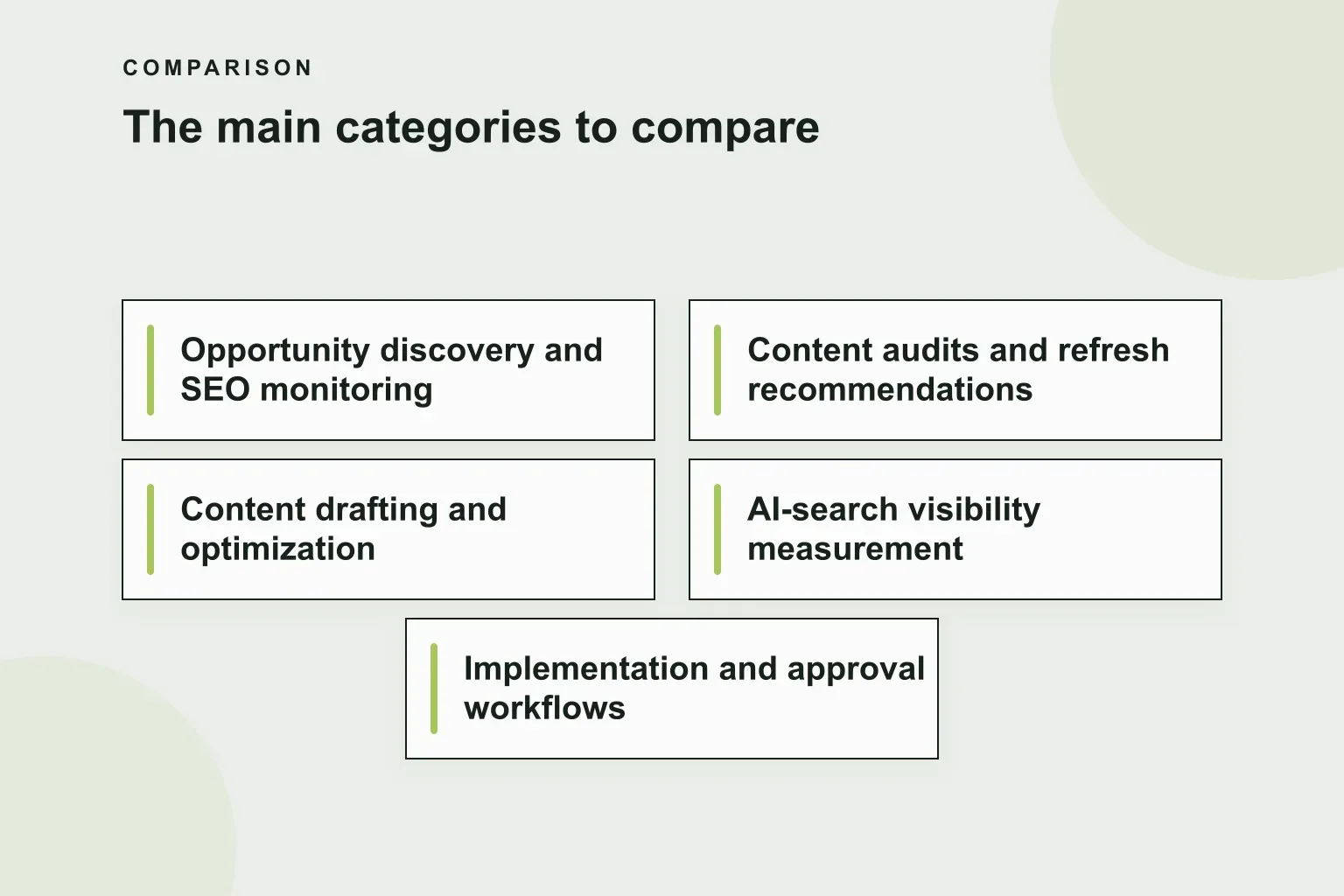
Opportunity discovery and SEO monitoring
These tools help teams inspect ranking changes, search visibility, and—when connected—Search Console data. They may be useful for identifying pages close to improvement, investigating a decline, or finding queries without a suitable ranking page.
The important question is not how many keywords a tool displays. Ask whether each opportunity includes enough context to act: the query, associated page, observed data, search intent, and a clear next decision.
Content audits and refresh recommendations
Content-audit tools inspect existing pages for gaps, outdated information, weak structure, unclear targeting, or opportunities to improve depth. They are most useful when a relevant page already exists and needs a deliberate refresh rather than a completely new draft.
A useful recommendation explains what should change and why. “Add more content” is not an audit. Look for a missing subtopic, a confusing section, a weak internal link, or a mismatch between the page and the query.
For a related guide to content structure, see Anatomy of a blog post — RomeoSEO.
Content drafting and optimization
Generative AI can help create outlines, rewrite sections, summarize supplied research, and produce first drafts. It can also assist with titles, descriptions, headings, and supporting copy.
Drafting is only one part of optimization. Test whether the tool preserves factual accuracy, distinguishes evidence from suggestions, understands the intended audience, and leaves room for editorial review. A polished draft can still target the wrong intent or make claims that the source material does not support.
AI-search visibility measurement
This category addresses the separate question of how a business appears in AI-generated answers. Before choosing a product, ask what prompts or queries it evaluates, what output it records, how often results can change, and whether the resulting observations can be checked by a person.
Do not treat a visibility score as self-explanatory. You need to know what was measured, when it was measured, and whether the output leads to an action such as checking a source page, correcting an inaccurate description, or improving information on your site.
Implementation and approval workflows
Some tools stop at recommendations. Others help prepare customer-facing changes for implementation. For teams that review work before it reaches the site, this distinction can matter more than the presence of a generative writing feature.
A reviewable workflow should show the proposed change, target page, supporting reasoning, and approval state. It should also let a reviewer reject or revise a recommendation without losing the surrounding context. The SEO automation use case from Gumloop is a useful example of how the market describes automation with AI agents; treat it as a description of that use case, not as independent proof of performance or suitability for your site.
A practical comparison of tool types and examples
The following comparison keeps the evidence boundary visible. The named examples come from the supplied profile or research sources; the capabilities and claims of any product should be verified directly before purchase.
| Tool type or example | What it may help you evaluate | Evidence to require | Review question or limitation |
|---|---|---|---|
| SEO workflow platform, such as RomeoSEO | Existing-ranking and content audits, keyword opportunities, content improvements, and delivery as pull requests or CMS drafts | Current rankings, Search Console data, the existing page, the content brief, and the proposed change | Does the recommendation address an existing page or should a new page be created? Can a reviewer approve the actual change? |
| AI-agent SEO automation use case, such as the one described by Gumloop | Repetitive SEO tasks organized into an automation workflow | The inputs, steps, outputs, and handoff defined for the specific workflow | Which steps are observations, which are generated suggestions, and where does human review occur? |
| AI-search visibility tool | Monitoring how a business or topic appears in AI-generated answers | A documented prompt set, captured answers, dates, sources, and a method for checking changes | Does it measure AI-answer visibility directly, or is it only reporting conventional rankings? |
| Content drafting or optimization tool | Outlines, rewrites, summaries, and first-pass content recommendations | The source material, target query, intended audience, and factual review process | Can it preserve accurate claims and avoid producing generic or unsupported copy? |
| Free AI tool used for a narrow SEO task | Brainstorming, organizing research, comparing title options, or creating a checklist | A repeatable input, saved output, and time required to verify it | Are limits on data access, history, volume, collaboration, or implementation acceptable? |
The MarketerMilk roundup of SEO automation tools can help you see the kinds of products included in this broader market. It is a roundup, not independent verification of every ranking, feature, or performance claim, so use it to expand your shortlist rather than to skip product evaluation.
A practitioner discussion such as this Reddit conversation about automated SEO tasks can add useful workflow ideas. It should be treated as practitioner experience, not authoritative performance evidence.
How to evaluate an AI SEO tool
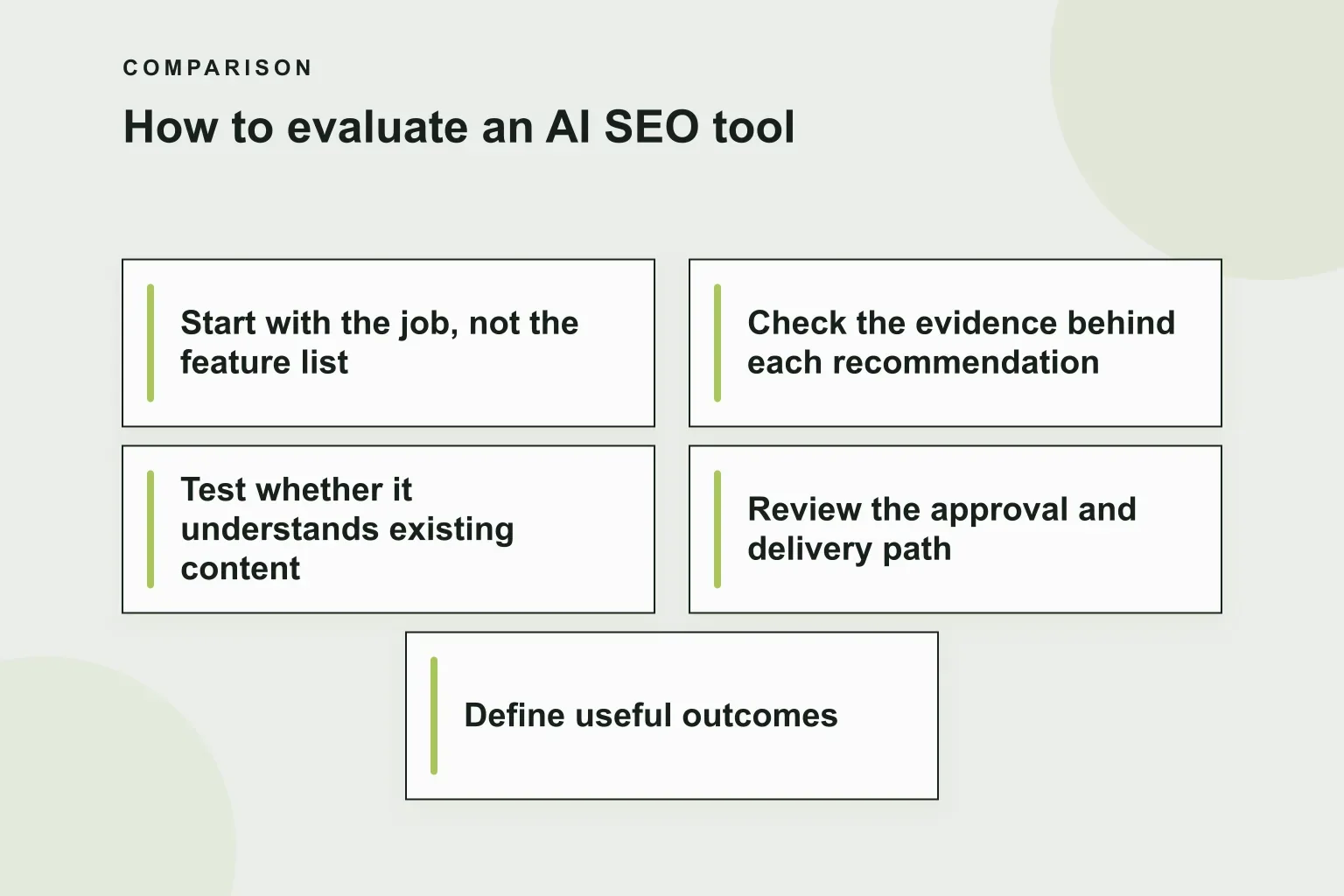
1. Start with the job, not the feature list
Write down the recurring task you want to improve. For example:
- Finding realistic page-two opportunities
- Reviewing rankings and Search Console data week over week
- Refreshing existing content before creating a new page
- Detecting possible keyword cannibalization
- Preparing titles, metadata, internal links, or content changes for review
- Observing how a defined set of questions represents your business in AI-generated answers
This prevents a common buying mistake: choosing a tool because it has an impressive AI feature that does not solve your team’s actual bottleneck.
2. Check the evidence behind each recommendation
Ask what the tool uses to produce its output. Depending on the task, useful evidence may include ranking history, Search Console data, the current page, related queries, existing site content, a defined prompt set, or a content brief.
You should be able to distinguish an observation from a generated suggestion. A tool that explains its evidence is easier to review and less likely to turn generic SEO advice into unnecessary work.
3. Test whether it understands existing content
New content is not always the right answer. A relevant page may already exist but need a refresh, clearer targeting, stronger internal links, or a correction to the page that is ranking.
Use one test case to see whether the tool considers existing pages before recommending another one. This matters when several pages address similar topics and may compete with one another.
4. Review the approval and delivery path
Ask how a completed change reaches your website. Possible outputs include a recommendation, a draft, a pull request, or a CMS draft. The right option depends on how your team works, but the transition should be explicit.
For many teams, useful SEO automation AI is not “publish everything.” It is automation that handles repetitive analysis and prepares changes while keeping a human approval step before publication.
5. Define useful outcomes
Set a baseline before you automate. Useful measures may include time spent on recurring audits, the number of approved improvements shipped, the percentage of recommendations accepted, or changes in the performance of refreshed pages.
For AI-search visibility work, define what you will record and compare: the prompt set, the observed answer, the cited or mentioned sources, the date, and the action taken. Avoid treating output volume or a single visibility score as proof of success.
Free AI tools for SEO optimization: what is realistic?
Free AI tools for SEO optimization can be useful for narrow tasks, experimentation, and learning. You might use them to organize an outline, generate questions to investigate, compare title options, or create a first-pass checklist.
Free tools are less likely to provide a complete, connected workflow across an existing site. Limits may apply to data access, project history, usage volume, collaboration, or implementation. Those constraints do not make a free tool useless; they make it important to define the boundary of the experiment.
Start with one existing page and one clearly defined task. Record the source information, the tool’s recommendation, the edits you would approve, and the time required to check the result. That comparison will tell you more than a long list of claimed features.
Common mistakes when adopting AI search optimization tools
Automating publication before review
SEO changes affect customer-facing pages. Treat generated recommendations and drafts as work to evaluate, not as proof that a change is ready to publish.
Treating conventional rankings as AI-answer visibility
Ranking data and AI-generated answers can inform different decisions. Confirm that the tool measures the search experience you care about instead of assuming that one metric represents both.
Confusing volume with quality
More briefs, rewrites, and suggested links do not necessarily produce better organic performance. Prioritize recommendations connected to a real page, query, audience need, and measurable decision.
Creating new pages too quickly
A new page can worsen cannibalization when an existing page could address the opportunity. Check the current site before opening a new content task.
Accepting unsupported claims
AI-generated copy may sound confident even when its underlying information is incomplete. Verify product details, customer claims, statistics, and recommendations against reliable source material.
Ignoring the handoff
A recommendation that cannot be reviewed, assigned, edited, and shipped is not a complete workflow. Include the operational path in your evaluation from the beginning.
Frequently asked questions
Are AI search optimization tools the same as AI writing tools?
No. AI writing tools focus primarily on generating or editing text. AI search optimization tools may include writing assistance, but they can also cover monitoring, content audits, keyword opportunities, internal links, technical recommendations, AI-answer visibility, and implementation workflows.
Are the best free AI tools for SEO always enough?
Not necessarily. Free tools can be a good fit for a narrow, occasional task. Teams managing an existing content library may need connected data, repeatable audits, collaboration, or an approval path that a free tool does not provide.
Should AI SEO tools replace an SEO specialist?
They are better viewed as workflow assistance. A specialist or knowledgeable website owner still needs to judge intent, business relevance, factual accuracy, prioritization, and whether a proposed change is safe to ship.
What should I test first?
Choose one existing page with a specific problem and a measurable goal. Test whether the tool can explain the opportunity, produce a relevant recommendation, distinguish traditional SEO from AI-search visibility work, and deliver an editable result that fits your review process.
The practical takeaway
The best AI search optimization tool is not necessarily the one with the most automated features. It is the one that measures the search experience you care about, connects evidence to a useful decision, handles repetitive work responsibly, and gives your team a clear way to review and ship the result.
For a workflow centered on audits, content improvements, keyword opportunities, and reviewable delivery, visit RomeoSEO — SEO work, shipped as pull requests to join the waitlist. You can also explore the RomeoSEO blog for more guidance on planning and improving SEO content.