
RomeoSEO9 min read
Semrush vs Ahrefs vs Moz: Pick Your First SEO
Compare Semrush, Ahrefs, and Moz on price, entry-plan limits, backlinks, audits, and AI visibility, with verdicts by budget, use case, and team size.
Summary of the Article
Semrush, Ahrefs, and Moz all cover keyword research, backlinks, site audits, and rank tracking, but they differ in cost, data strengths, and how easy they are to learn. Pick by your main job, not by feature lists: Semrush for broad marketing work, Ahrefs for backlink and competitor research, Moz for the friendliest, cheapest full-suite start.
- Semrush: widest all-in-one coverage, including PPC research and a built-in AI visibility toolkit; entry plan starts at $139 per month and one seat.
- Ahrefs: strongest backlink index and organic competitor research; the $29 Starter plan is cheap but tightly limited, and full plans start at $129.
- Moz: beginner-friendly workflows and Domain Authority; the cheapest full-suite entry at $49 per month, but smaller data depth and tighter research quotas.
- Free first: Ahrefs Free (formerly Webmaster Tools) and a limited Semrush free account cost nothing, and Moz offers a trial.
None of the three is best at everything. This guide shows what each entry plan really includes, where each tool falls short, and which one fits your budget and team.
Semrush vs Ahrefs vs Moz: Which Should You Buy First?
You are about to spend real money on an SEO suite, and every comparison you find seems to say the same thing: they are all good. That is true and useless. The better question is which one matches what you will actually do each week.
This comparison starts with a decision rule, then looks at what each tool's cheapest plan really buys you, because headline prices hide the limits that matter.
The Short Answer: How to Choose
Ask yourself three questions before you compare features:
- What is your main job? Finding keywords, studying competitors' backlinks, fixing technical issues, or tracking rankings?
- What is your realistic monthly budget, including extra seats?
- How much time do you have to learn the tool?
If you want one login for SEO plus other marketing work (ads, social, content), lean Semrush. If your edge comes from links and organic competitor research, lean Ahrefs. If you want the easiest start at the lowest full-suite price, lean Moz.
Here is the comparison table at a glance. Prices are the entry plans, billed monthly, checked against each vendor's pricing pages in late 2026. Pricing changes often, so confirm on each vendor's site before you buy.
| Semrush | Ahrefs | Moz | |
|---|---|---|---|
| Best for | Broad all-in-one marketing work | Backlink and competitor research | Beginners and tight budgets |
| Keyword research | Strong, with PPC data too | Strong | Good, quota-limited on cheap plans |
| Backlink data | Strong | Widely considered the strongest | Good, smaller index |
| Site audits | Yes | Yes | Yes |
| Rank tracking | Yes | Yes (750 keywords on entry full plan) | Yes (300 keywords on Standard) |
| AI visibility tracking | Built-in AI Visibility Toolkit | AI prompt checks from the Lite plan | AI prompt tracking on Standard and up |
| Entry price | $139/mo (SEO plan) | $29 Starter / $129 Lite | $49 Starter / $99 Standard |
| Free option | Free account, 10 reports/day | Free account for verified sites | Free Community account and trial |
Now the detail, one tool at a time.
Semrush: Best When You Use More Than Just SEO
Semrush sells itself as an all-in-one marketing platform, and its current lineup starts with the SEO plan. On Semrush's pricing page, the SEO plan is $139 per month billed monthly, or about $117.33 per month billed annually. Note that Semrush restructured its plans in 2026 (older reviews mention Pro, Guru, and Business tiers), so ignore plan names in older articles and check the current page.
What the entry plan includes:
- Up to 5 projects (websites to monitor)
- Keyword research and competitor analysis tools
- Position Tracking, backlink data, and Site Audit
- One user; extra seats cost extra (about $45/mo per additional user as add-on)
Two things set Semrush apart for a first-time buyer:
- Breadth beyond SEO. Semrush also covers PPC research, social, and content marketing tools. If you only do SEO, you pay for breadth you may not use. If you handle several marketing jobs, that breadth is the reason to pick it.
- AI visibility is built in. Semrush bundles its AI Visibility Toolkit into its plans. It tracks how brands appear in AI answers on platforms like ChatGPT, Google AI Mode, and Gemini, with prompt research and daily prompt tracking.
Where Semrush falls short: the entry price is the highest of the three, and the entry plan covers one user. A two-person team pays noticeably more than the sticker price once you add a seat. Also, that depth takes time to learn; Semrush has the biggest interface of the three.
Ahrefs: Best for Backlinks and Competitor Research
Ahrefs is known for its backlink index and for showing how competitors get their organic traffic. If your main fight is "why does that site outrank us," Ahrefs gives the clearest answers.
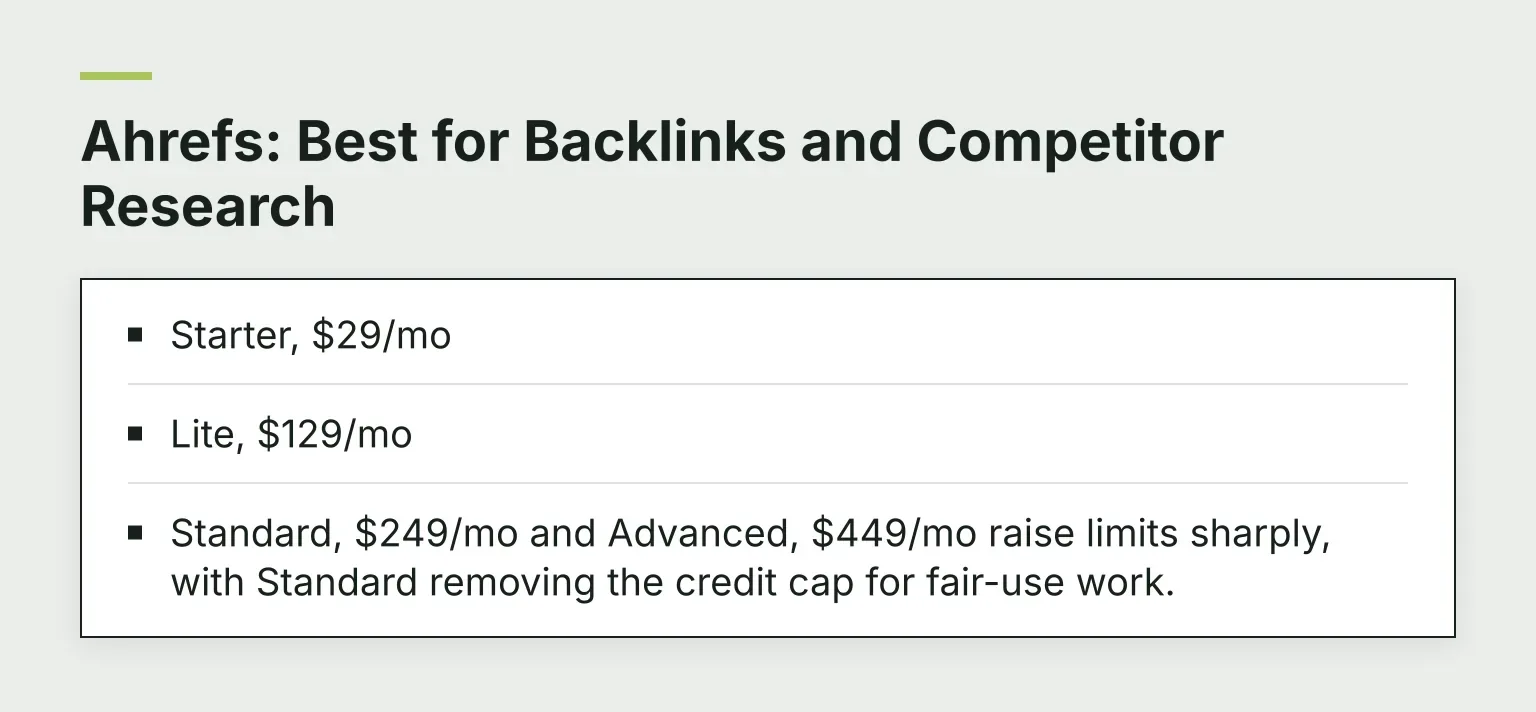
Its pricing has an important split that first-time buyers often miss. On Ahrefs' pricing page:
- Starter, $29/mo: a real, cheap entry point. But it works on a credit system (about 200 credits per month), supports only 1 unverified project, tracks just 50 keywords, and limits historical data to one month. It is a taster, not a full workspace. Per Ahrefs' own help center, you cannot add users or buy extra credits on Starter.
- Lite, $129/mo: the first full plan. It includes 750 tracked keywords, 6 months of historical data, 5 unverified projects, up to 2 extra users ($40/mo each), and 150 AI prompt checks per month.
- Standard, $249/mo and Advanced, $449/mo raise limits sharply, with Standard removing the credit cap for fair-use work.
Where Ahrefs falls short: the gap between $29 and $129 is large, and the $29 plan's limits surprise people. Content and keyword tools are SEO-focused, so if you also want ads or social data, Ahrefs is not that. Extra users cost more than on some rivals.
Moz: Best Cheap Full Suite for Beginners
Moz built its name on Domain Authority, the link-strength score many teams still quote in meetings, and its workflows are the friendliest of the three. If you have never run an SEO suite before, Moz's reports make the most sense on day one.
On Moz's pricing page, Moz Pro runs:
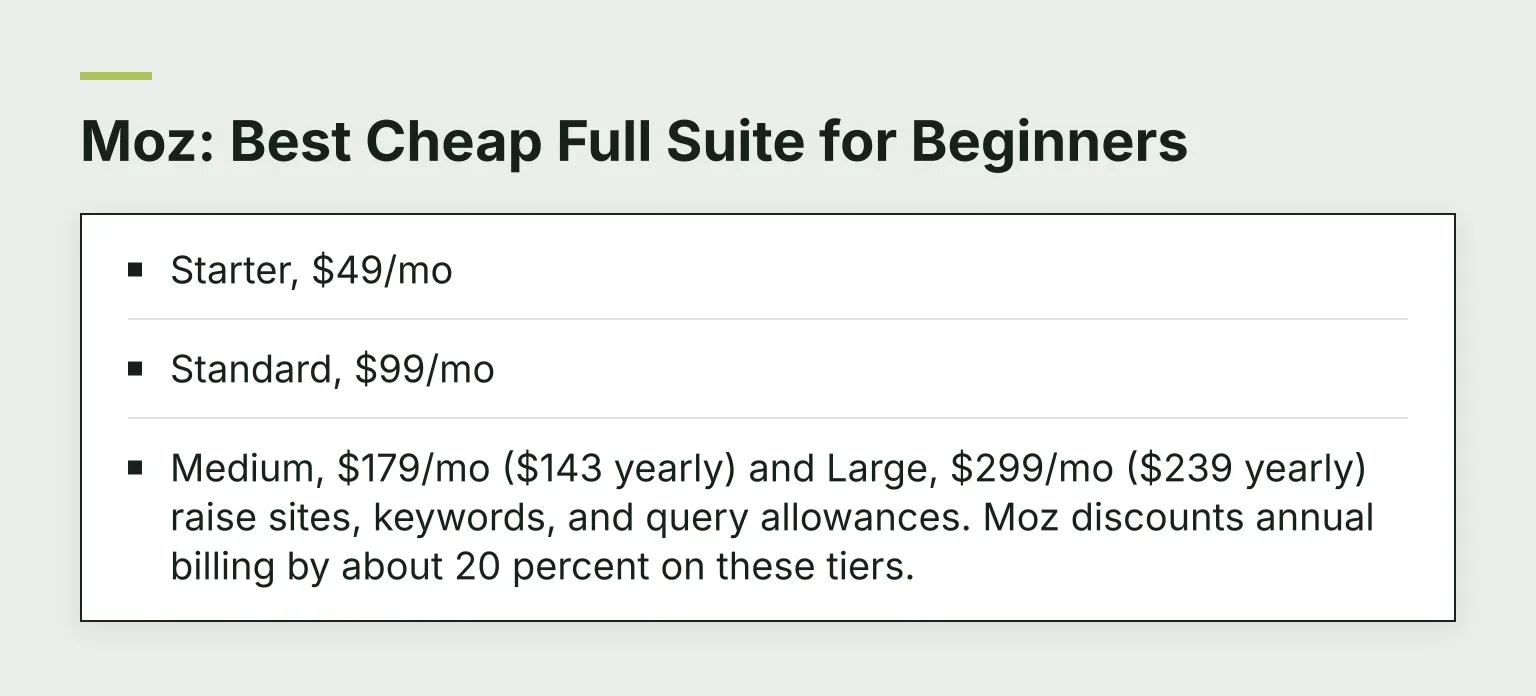
- Starter, $49/mo: one site, about 50 tracked keywords and 75 keyword research queries per month. Monthly billing only. Real, but tight; heavy researchers burn through the query allowance fast.
- Standard, $99/mo ($79/mo billed yearly): 3 sites, 300 tracked keywords, 150 keyword queries, plus AI prompt tracking.
- Medium, $179/mo ($143 yearly) and Large, $299/mo ($239 yearly) raise sites, keywords, and query allowances. Moz discounts annual billing by about 20 percent on these tiers.
Where Moz falls short: its keyword and backlink databases are smaller than the other two, so you will hit data gaps in competitive niches. Research quotas on the cheap plans are the tightest here. And the $49 Starter tier leaves out some features that Standard includes, so treat it as a starter, not the full suite.
Free Options and Trials: Test Before You Buy
Do not pay before you have tried the free routes. All three give you something for nothing:
- Ahrefs Free (the renamed Ahrefs Webmaster Tools, per Ahrefs' free page): free forever for your own verified websites, including Site Audit with 5,000 crawl credits per project per month and backlink data for your own site. No credit card. This alone covers basic auditing for one site.
- Semrush free account: about 10 reports per day across core tools, one demo project, and 10 keywords tracked, per Semrush's free account guide. Enough to test the interface for a week of light use.
- Moz: a free Community account with limited tools, plus a trial of Moz Pro.
A practical plan: spend two weeks with the free tiers on your real site. Whichever interface you keep opening is usually the right suite to buy.
How They Differ on AI Search Visibility
By 2026, all three track how visible you are in AI answers, but in different ways:
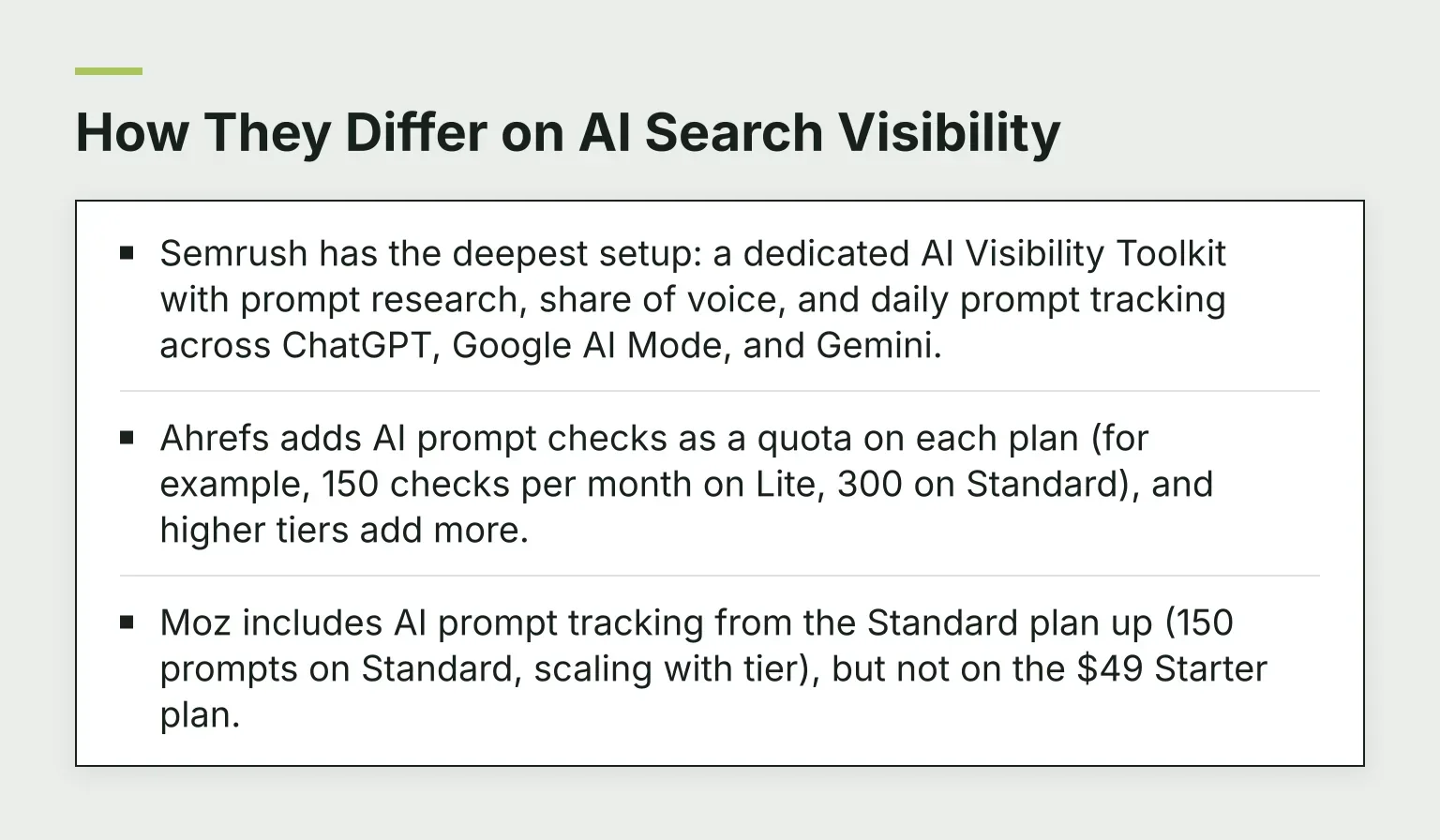
- Semrush has the deepest setup: a dedicated AI Visibility Toolkit with prompt research, share of voice, and daily prompt tracking across ChatGPT, Google AI Mode, and Gemini.
- Ahrefs adds AI prompt checks as a quota on each plan (for example, 150 checks per month on Lite, 300 on Standard), and higher tiers add more.
- Moz includes AI prompt tracking from the Standard plan up (150 prompts on Standard, scaling with tier), but not on the $49 Starter plan.
If AI-search visibility is central to your strategy, Semrush currently goes furthest. If you just want to watch a handful of prompts, the quota on Ahrefs Lite or Moz Standard is enough to start.
Verdicts: Which Tool for Which Reader
- Solo site owner, small budget: Start with Ahrefs Free or a Semrush free account. If you want a paid suite, Moz Starter at $49 is the cheapest full-suite entry, but check whether 50 keywords and 75 queries fit your work. Ahrefs Starter at $29 is cheaper still, but its limits make it a testing tool.
- Link-building-focused SEO or consultant: Ahrefs. The backlink index and competitor research are the reason to choose it, and the Lite plan covers most solo workloads. Budget $129, not $29.
- Small marketing team handling SEO plus other channels: Semrush. The breadth pays off when several people use one subscription for different jobs. Plan for the seat cost, not just the base plan.
- Established site recovering rankings: Any of the three handles audits and rank tracking; pick by the data you need most. If you need criteria for judging tools by data and workflow rather than brand, our guide to choosing an SEO analysis tool walks through that.
When the Right Answer Is None of the Three
These suites are research dashboards. They tell you what to do; they do not do it. If your bottleneck is not research but execution, such as preparing new pages, updating existing ones, and adding internal links, a narrower tool may fit better. Our roundup of 11 Semrush alternatives covers cheaper and more focused options, including lower-budget picks like Ubersuggest-style tools for readers searching for a lighter suite.
That includes us. RomeoSEO works differently: it uses your site's pages, rankings, and connected Search Console data to find keyword and content opportunities, then prepares new or improved pages, internal links, and images as changes for human review before anything goes live. If you want review-ready SEO changes rather than another dashboard, join the RomeoSEO waitlist with your email and be first in line when onboarding opens.
Whichever route you take, decide by your main weekly job and your real budget, try the free tier first, and recheck prices on the vendor's own page before you commit.