
RomeoSEO9 min read
SEO Automation Software: How to Choose a Tool
Compare SEO automation software by workflow fit, evidence, human review, and output quality. Learn what to automate and where judgment still matters.
SEO automation software helps teams turn recurring search work into a repeatable workflow. Instead of checking rankings, finding content issues, planning updates, and moving recommendations between tools by hand, a team can use software to identify opportunities and organize the next action.
That does not mean SEO becomes fully automatic. Search intent still needs judgment. Content changes still need review. And an automated recommendation is only useful when it is based on the right page, keyword, and evidence.
The best approach is to automate the repetitive parts of SEO while keeping important decisions in an approval workflow. This guide explains what automated SEO software typically does, which capabilities matter, where automation has limits, and how to evaluate SEO automation tools for your team.
What is SEO automation software?
SEO automation software is a category of tools that uses rules, scheduled checks, data connections, or AI-assisted workflows to reduce manual SEO work. Depending on the product, it may help with tasks such as:
- Monitoring rankings and changes in organic performance
- Finding pages that need updates
- Identifying title, meta description, internal-link, or content-depth opportunities
- Detecting keyword cannibalization or a page that may not match the intended query
- Creating briefs, drafts, or recommended page changes
- Sending work to an approval, pull-request, or CMS workflow
The phrase covers several different types of products. Some automated SEO tools focus on technical monitoring. Others focus on content optimization, keyword research, reporting, or publishing. A tool can be useful without covering every part of the SEO process.
The key distinction is between automating analysis and automating publication. Analysis can often be accelerated safely. Publishing changes directly to a live site requires a higher level of confidence, testing, and human oversight.
How SEO automation works in practice
A useful automated SEO workflow connects four stages: collect evidence, identify an opportunity, prepare a change, and review the result. The exact interface varies by product, but the underlying sequence should be understandable.
- Collect evidence. Bring together relevant ranking, search, page, and content information.
- Identify an opportunity. Find a page or topic where a specific change may improve the site’s ability to address search intent.
- Prepare the work. Turn the recommendation into a brief, content change, internal-link update, or other concrete deliverable.
- Review and ship. Check the recommendation, approve the change, and deliver it through the team’s chosen workflow.
A strong system should make it possible to see why an action was recommended. If a tool produces a list of tasks without showing the supporting page, query, or evidence, the resulting automation may create more review work rather than less.
What can automated SEO software handle?
Automation is most valuable when a task is repetitive, has a clear input and output, and can be checked by a person before it goes live.
Performance monitoring
Automated monitoring can surface week-over-week ranking changes and Search Console data without requiring someone to assemble the same report repeatedly. The useful output is not just a chart; it is a clear indication of what changed and whether the change deserves investigation.
Content refresh recommendations
Automated SEO software can help identify pages that may benefit from improved titles, meta descriptions, internal links, or content depth. The recommendation should remain connected to the page’s existing purpose. Updating a page simply because it is old can be less useful than improving a page with a clear ranking or intent problem.
Keyword and page opportunity analysis
Some SEO automated software helps teams connect keyword opportunities to the page most likely to address them. This can reduce the risk of creating a new page when an existing page should be refreshed—or refreshing a page that cannot satisfy the opportunity.
Cannibalization and ranking-page checks
When multiple pages appear to target similar topics, automation can help flag possible keyword cannibalization or an incorrect ranking page. These alerts are starting points for investigation, not automatic proof that pages should be merged, deleted, or rewritten.
Content production and delivery
Certain tools can assist with briefs, page drafts, and recommended changes. For a team that needs an approval workflow, delivery matters as much as generation. A draft that can be reviewed as a pull request or CMS draft is easier to discuss, revise, and approve than an unexplained change made directly to a live page.
How to evaluate the best SEO automation tools
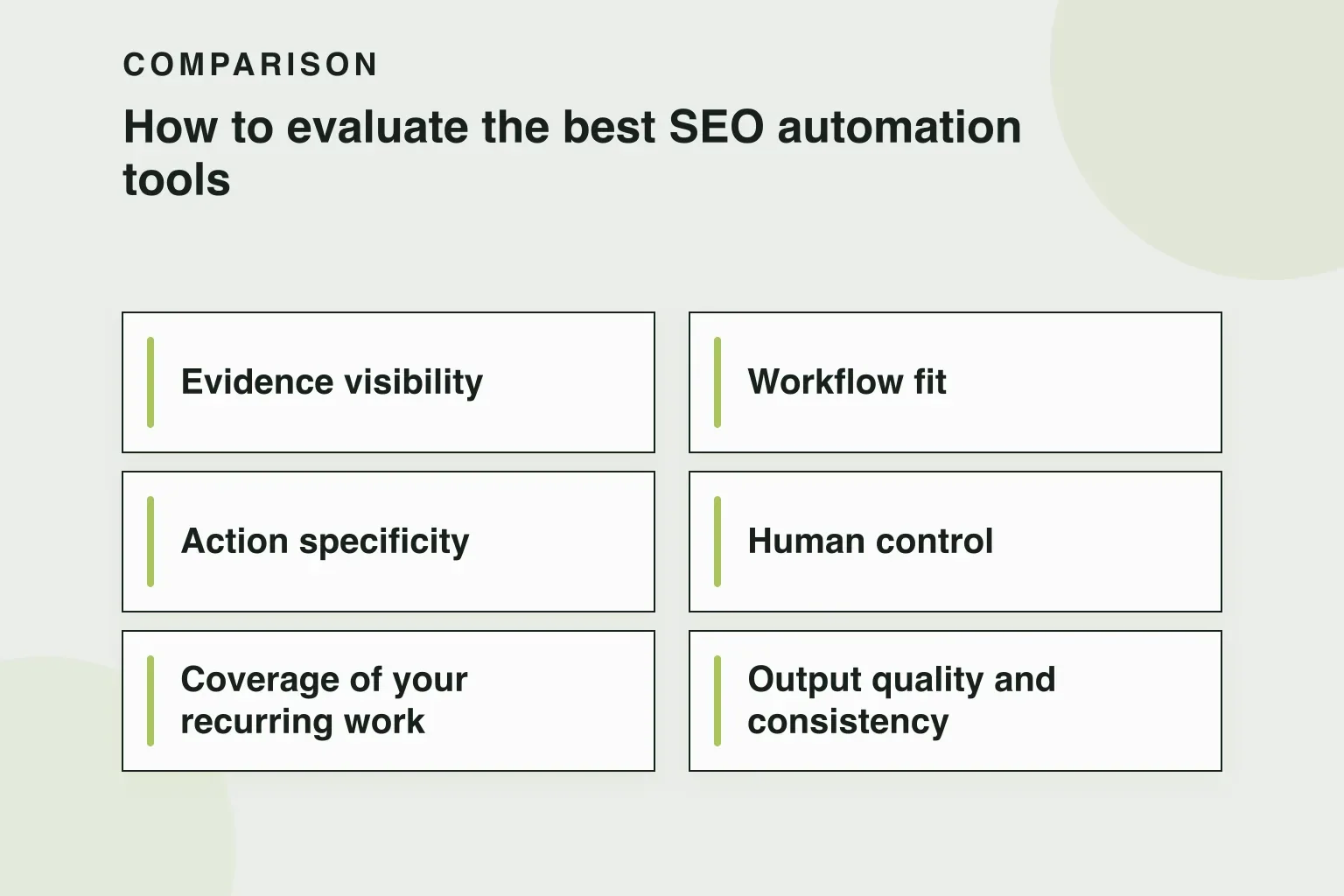
There is no single best SEO automation software for every team. Compare tools against the work you actually need to repeat and the level of control your site requires.
1. Evidence visibility
Can the tool show the data or page context behind a recommendation? Look for links to the affected page, the relevant query, the observed change, and the reason the task was created.
2. Workflow fit
Does the tool fit the way your team already reviews work? Consider whether it supports assignments, drafts, pull requests, CMS delivery, or another approval method that your team can realistically maintain.
3. Action specificity
“Improve SEO” is not an actionable task. A useful recommendation identifies the page, the problem, and the proposed change clearly enough for someone to review it.
4. Human control
Check whether you can approve, edit, reject, or defer recommendations. Automation should reduce repetitive work without removing the decisions that depend on brand knowledge, business context, or editorial judgment.
5. Coverage of your recurring work
List the SEO tasks your team performs every week or month. Then check whether a tool addresses those tasks rather than selecting a product because it has the longest feature list. A focused workflow can be more valuable than a broad but disconnected collection of features.
6. Output quality and consistency
Review sample recommendations or drafts. Are they specific to the page and query, or could they have been written for any site? Consistency matters when several people review or publish SEO work.
What SEO automation cannot decide reliably
Automation has limits because SEO decisions often depend on context that is difficult to reduce to a rule.
A tool may identify that two pages overlap, but it cannot always determine which page best serves readers and the business. It may suggest adding a keyword, but that does not prove the wording belongs in the page. It may generate a draft, but factual accuracy, voice, differentiation, and usefulness still require review.
Be especially cautious with workflows that:
- Treat every ranking decline as a content problem
- Recommend changes without showing supporting evidence
- Rewrite pages without preserving their purpose or important facts
- Create pages for every keyword variation
- Publish automatically without an approval step
- Present estimated outcomes as guarantees
The safest operating model is not “set it and forget it.” It is a documented loop in which software finds and prepares work, while a person validates the recommendation and approves the change.
A practical way to introduce SEO automation
Start with one recurring workflow instead of automating the entire SEO program at once. For example, a team might begin by reviewing page-two opportunities, then expand into content refreshes or internal-link recommendations once the review process is working.
Define what counts as a useful recommendation before turning on automation. At minimum, each task should identify the page, the search opportunity or observed issue, the proposed action, and the evidence a reviewer should check.
Then measure operational outcomes rather than promising a particular ranking result. Useful questions include:
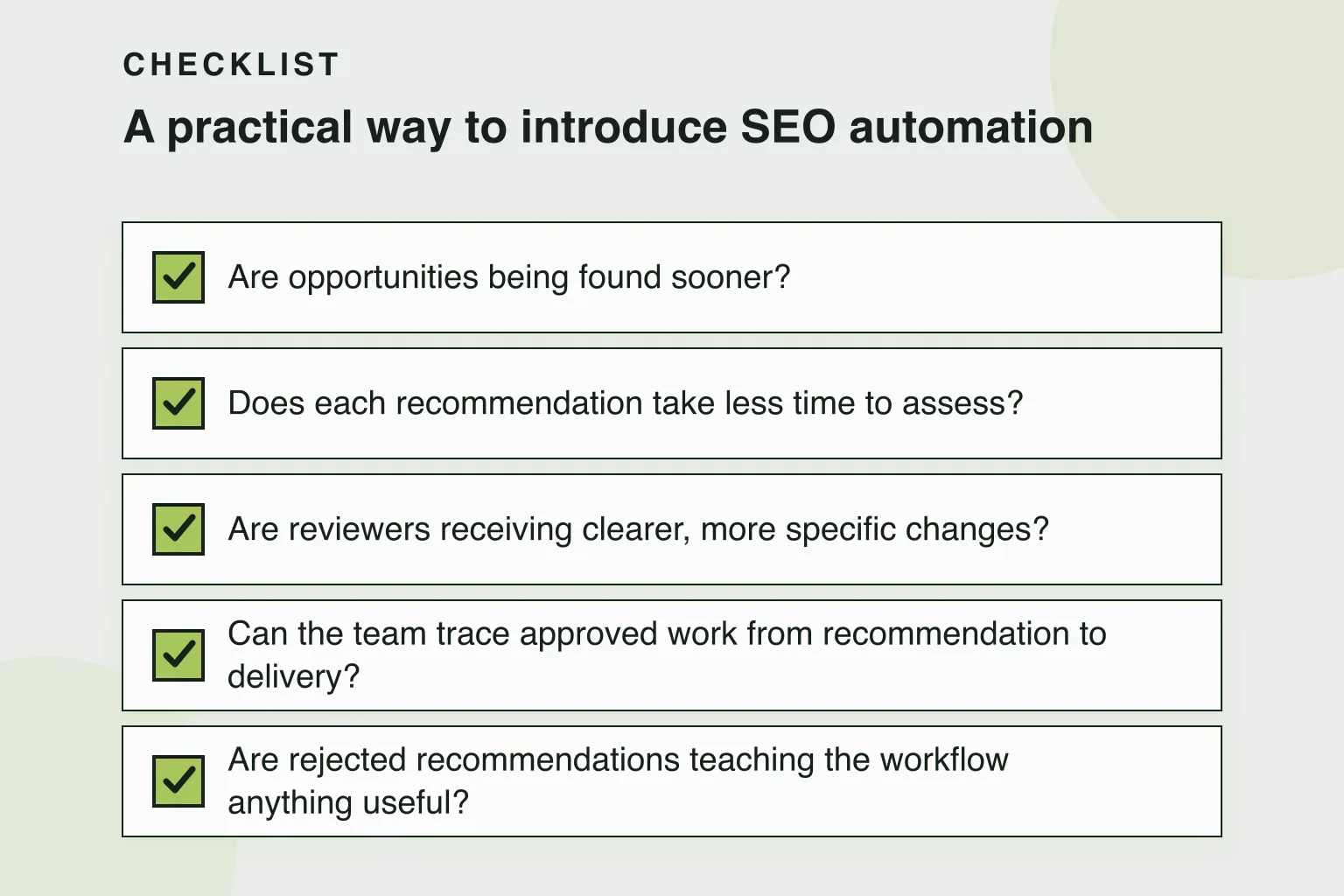
- Are opportunities being found sooner?
- Does each recommendation take less time to assess?
- Are reviewers receiving clearer, more specific changes?
- Can the team trace approved work from recommendation to delivery?
- Are rejected recommendations teaching the workflow anything useful?
This approach makes automated SEO tools accountable to the process they are meant to improve.
Where RomeoSEO fits
RomeoSEO is designed for website owners and teams with existing SEO content who want to improve organic performance and ship changes through an approval workflow. It audits existing rankings and content, identifies SEO fixes and keyword opportunities, writes page changes and new content, and delivers the work as pull requests or CMS drafts for approval.
That makes it relevant when the problem is not merely finding another SEO report. The practical need may be turning evidence into a reviewable change: improving a page-two ranking, correcting an internal-link issue, refreshing existing content, or deciding whether a new page is warranted.
For more examples of the content work that supports this process, visit the RomeoSEO blog or read Anatomy of a blog post. If you want to learn more about the workflow, visit RomeoSEO to join the waitlist.
Frequently asked questions
Is SEO automation software the same as an SEO platform?
Not necessarily. “SEO platform” is a broad label for software that may include research, auditing, reporting, content, or technical features. SEO automation software emphasizes reducing manual steps through scheduled analysis, recommendations, assisted production, or workflow delivery. A platform may contain automation, but the labels are not interchangeable.
Are automated SEO tools safe to use?
They can be useful when recommendations are evidence-based and reviewed before publication. Safety depends on the workflow, the quality of the underlying data, and the controls available to approve or reject changes. Automatic publication without meaningful review creates more risk than automatic monitoring or task preparation.
Should a small team use automated SEO software?
A small team may benefit if it has recurring SEO work but limited time to perform it manually. Start with a narrow use case and make sure the output is easy to validate. If configuring the tool takes more effort than the task it replaces, the workflow may not yet be a good candidate for automation.
Does automation replace an SEO specialist?
Automation can reduce repetitive analysis and production work, but it does not remove the need for judgment. Someone still needs to interpret intent, protect accuracy and brand context, prioritize opportunities, and approve changes.
Final takeaway
The best SEO automation tools do more than generate a long list of recommendations. They connect evidence to a specific action, fit an approval workflow, and make it clear where human judgment is still required.
Start with one repeatable SEO process, evaluate the quality of its outputs, and expand only when the workflow is reliable. For teams that want SEO work delivered as reviewable changes, go to the RomeoSEO homepage to join the waitlist.