
RomeoSEO10 min read
SEO Content Audit: A Practical Guide | RomeoSEO
Learn how to run an SEO content audit, evaluate intent and page fit, prioritize content fixes, and turn findings into approved SEO work. SEO Content Audit: A
An SEO content audit is a structured review of existing pages to find problems and opportunities that may affect organic visibility. Instead of checking only whether a page contains a target keyword, a useful audit considers search intent, ranking-page fit, titles, metadata, internal links, content depth, and whether the page is still the best result for the query.
The goal is not to make every page longer or force keywords into every paragraph. It is to decide what each page should do next: keep, improve, consolidate, redirect, or leave unchanged.
What is an SEO content audit?
An SEO content audit evaluates a website’s existing content against both searcher needs and search-performance evidence. It usually combines page-level analysis with broader checks across a site or content cluster.
A page-level review might examine:
- The query or topic the page is intended to address
- Whether the page matches the likely search intent
- The page title, meta description, headings, and URL
- Content depth, clarity, freshness, and factual accuracy
- Internal links to and from the page
- Signs of keyword cannibalization or the wrong page ranking
- Existing impressions, clicks, rankings, and conversions where data is available
A broader audit looks for patterns. For example, several pages may target the same topic, important pages may have no internal links, or older articles may attract impressions without earning enough clicks.
This is different from a technical SEO audit, although the two can overlap. A technical audit focuses more heavily on crawling, indexing, site performance, structured data, and other site-level conditions. An SEO content audit focuses on whether the content is relevant, useful, well-targeted, and properly connected to the rest of the site.
Why run an SEO content audit?
Content audits are most useful when a site already has enough pages and performance history to review. They can help you make better decisions before publishing another article that competes with something you already have.
Common reasons to audit include:
- Organic traffic or rankings have declined
- A page ranks on page two but has room to improve
- Multiple URLs appear to target the same query
- Content earns impressions but few clicks
- Important pages are outdated or difficult to find through internal links
- A content refresh is being considered, but the required changes are unclear
- New content is being planned and existing-page fit has not been checked
An audit does not guarantee higher rankings. Search results depend on many factors, and a recommendation may be correct even when the outcome is uncertain. The value of the audit is that it turns a vague “this page should perform better” assumption into a documented set of decisions and next actions.
How to perform an SEO content audit
A practical audit can be completed in five stages. The exact depth depends on the size of the site, the available data, and the importance of the pages being reviewed.
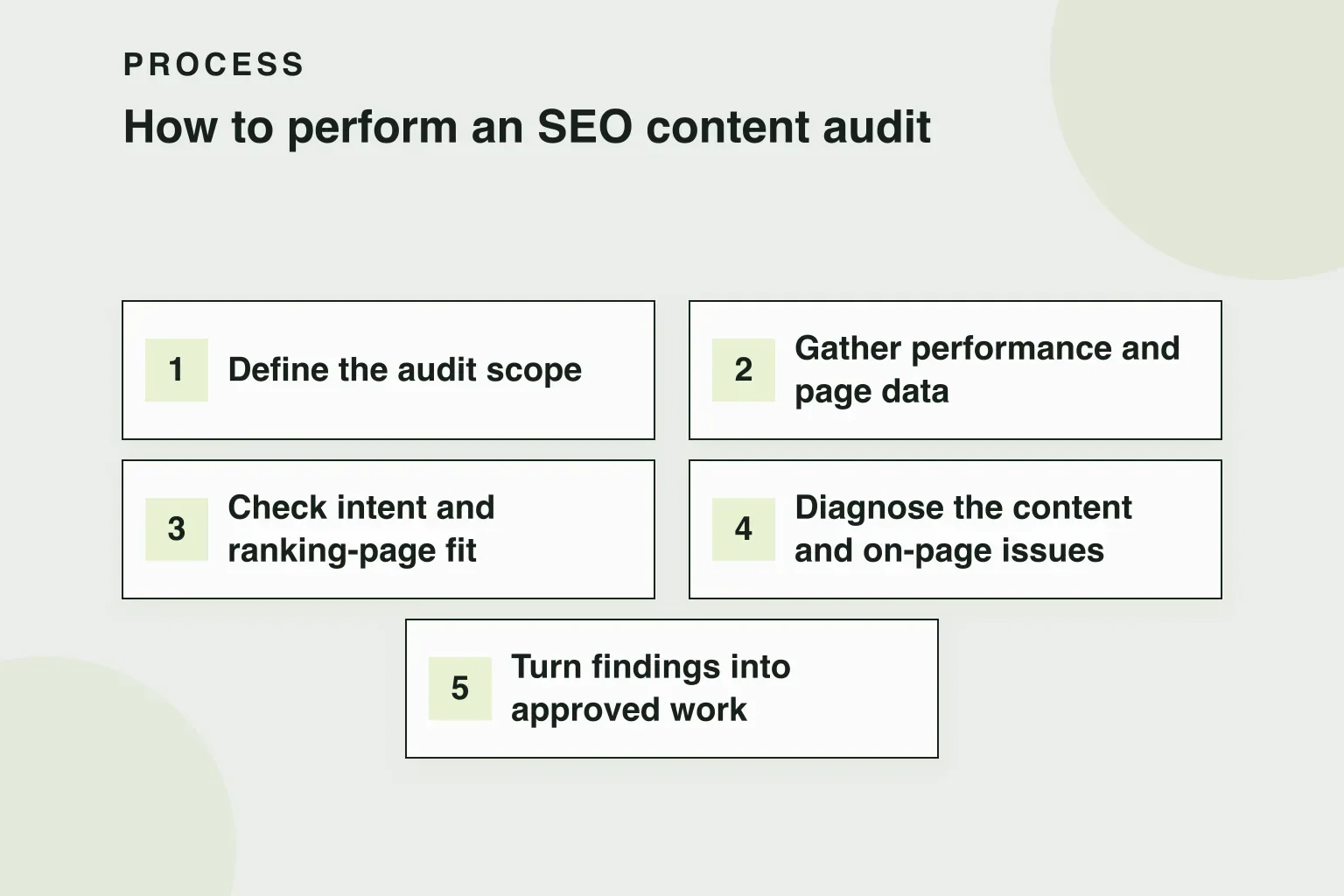
1. Define the audit scope
Start by deciding what you are reviewing. You might audit the whole site, one content type, a topic cluster, or a set of pages with declining performance.
Record the URL, page type, primary topic, intended audience, and current owner if those details are known. A clear scope prevents the audit from becoming an endless spreadsheet of low-priority observations.
For a focused audit, begin with pages that have one or more of these signals:
- They already receive organic impressions
- They rank for relevant queries but underperform on clicks
- They support an important business topic
- They have not been reviewed recently
- They overlap with another page
2. Gather performance and page data
Collect the evidence available for each URL. Search Console data can show impressions, clicks, click-through rate, and queries associated with a page. Ranking data can help reveal movement over time and whether the intended URL is ranking.
Then review the page itself. Note the title, meta description, H1, subheadings, main claims, links, calls to action, publication or update date, and any obvious gaps in the explanation.
Do not treat one metric as the verdict. A page with low clicks may have a title problem, weak demand, an intent mismatch, or a position that is too low to generate meaningful traffic. The data tells you where to investigate; it does not replace judgment.
3. Check intent and ranking-page fit
Ask what a searcher is trying to accomplish and whether the page helps them do it. A query may imply a definition, comparison, tutorial, product evaluation, or immediate action. The page should make that purpose clear early.
Also check whether the right URL is ranking. If two pages cover nearly the same topic, search engines may alternate between them or rank neither as strongly as you expect. That may call for consolidation, clearer internal linking, a revised target, or a decision to keep the pages distinct.
Review the current search results carefully when you have reliable access to them, but avoid copying competitors. Search results can help validate intent and content patterns; they do not prove that every ranking page’s length, headings, or claims are necessary for your audience.
4. Diagnose the content and on-page issues
Once intent and page fit are clear, identify the changes that could make the page more useful and easier to understand.
Useful review questions include:
- Does the opening answer the topic directly?
- Does the page cover the questions a reasonable reader would have next?
- Are the title and description accurate and compelling without exaggeration?
- Do headings create a logical path through the subject?
- Are important terms used naturally, without repetitive or awkward phrasing?
- Are claims current, specific, and supported where support is needed?
- Does the page link to relevant related content?
- Is the call to action appropriate for the reader’s stage?
- Are there sections that are redundant, thin, or no longer relevant?
Prioritize changes by expected reader value and implementation effort. A clearer answer, better page targeting, or stronger internal-link path may be more valuable than adding another paragraph of generic advice.
5. Turn findings into approved work
An audit is only useful if its findings become decisions. For every reviewed page, record a recommendation such as:
- Keep the page as-is and monitor it
- Refresh the existing content
- Improve the title, metadata, or internal links
- Expand or restructure specific sections
- Consolidate overlapping pages
- Redirect or remove content when there is no useful role for it
- Create a new page because existing content cannot satisfy the opportunity
Include the evidence behind the recommendation, the proposed changes, and any open questions. This makes review easier and reduces the risk of shipping speculative edits.
For teams that need an approval trail, RomeoSEO audits existing rankings and content, identifies SEO fixes and keyword opportunities, writes page changes and new content, and delivers the work as pull requests or CMS drafts for approval. Learn more on the RomeoSEO homepage.
What should an SEO content audit checklist include?
A checklist helps keep reviews consistent, but it should support judgment rather than turn the audit into a mechanical score. At minimum, check the page’s purpose, evidence, intent, content quality, relationships with other pages, and next action.
A useful checklist includes these questions:
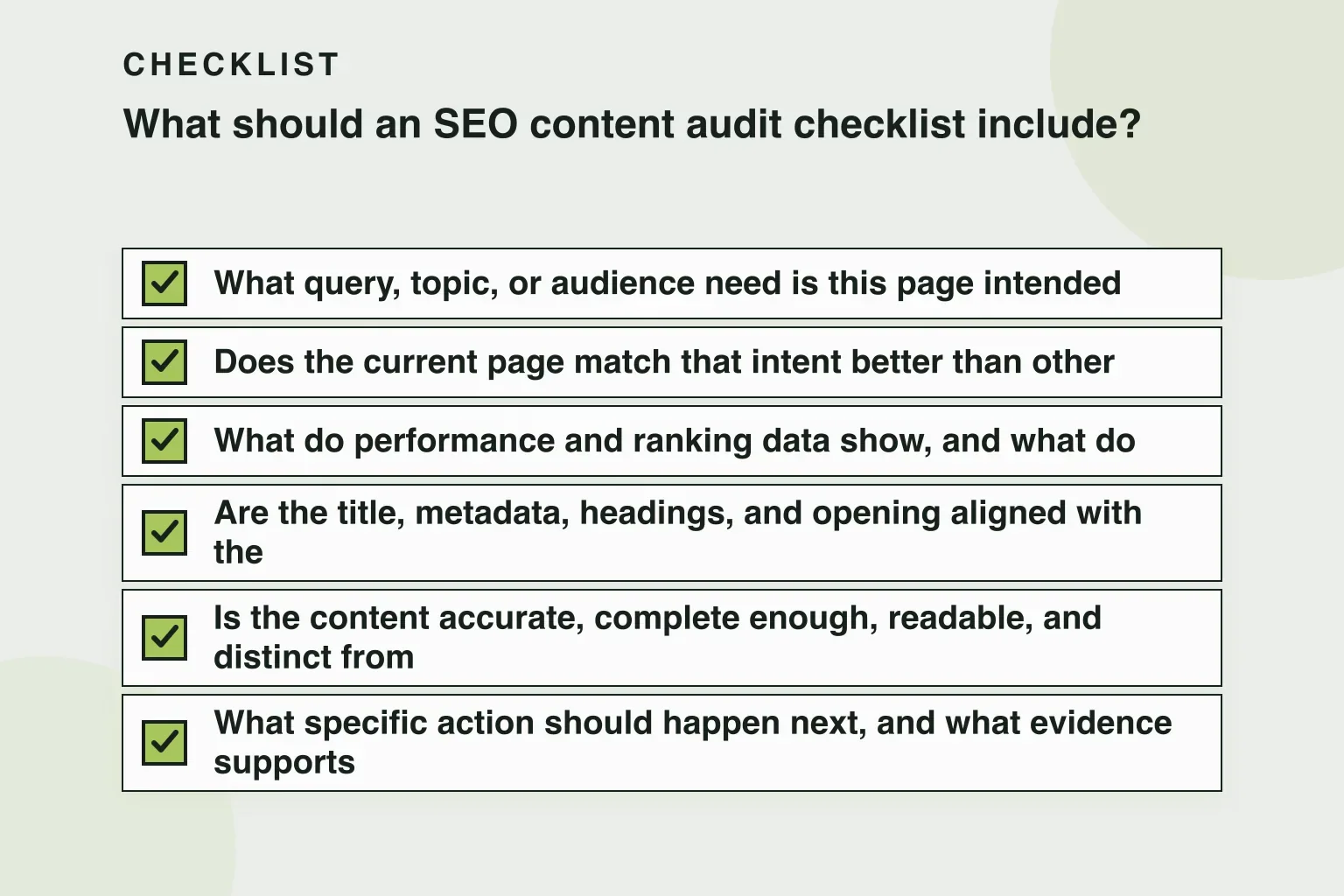
- What query, topic, or audience need is this page intended to serve?
- Does the current page match that intent better than other relevant URLs?
- What do performance and ranking data show, and what do they not show?
- Are the title, metadata, headings, and opening aligned with the page’s purpose?
- Is the content accurate, complete enough, readable, and distinct from nearby pages?
- What specific action should happen next, and what evidence supports it?
Keep the checklist tied to a decision. “Add more keywords” is not a sufficiently specific recommendation. “Clarify the comparison criteria, update the examples, and add an internal link from the related guide” gives a reviewer something concrete to assess.
Choosing an SEO content analysis tool
An SEO content analysis tool can speed up collection and comparison, especially when many URLs need to be reviewed. Tools may help surface rankings, queries, page elements, content coverage, links, or technical signals.
The right tool depends on the question you are trying to answer:
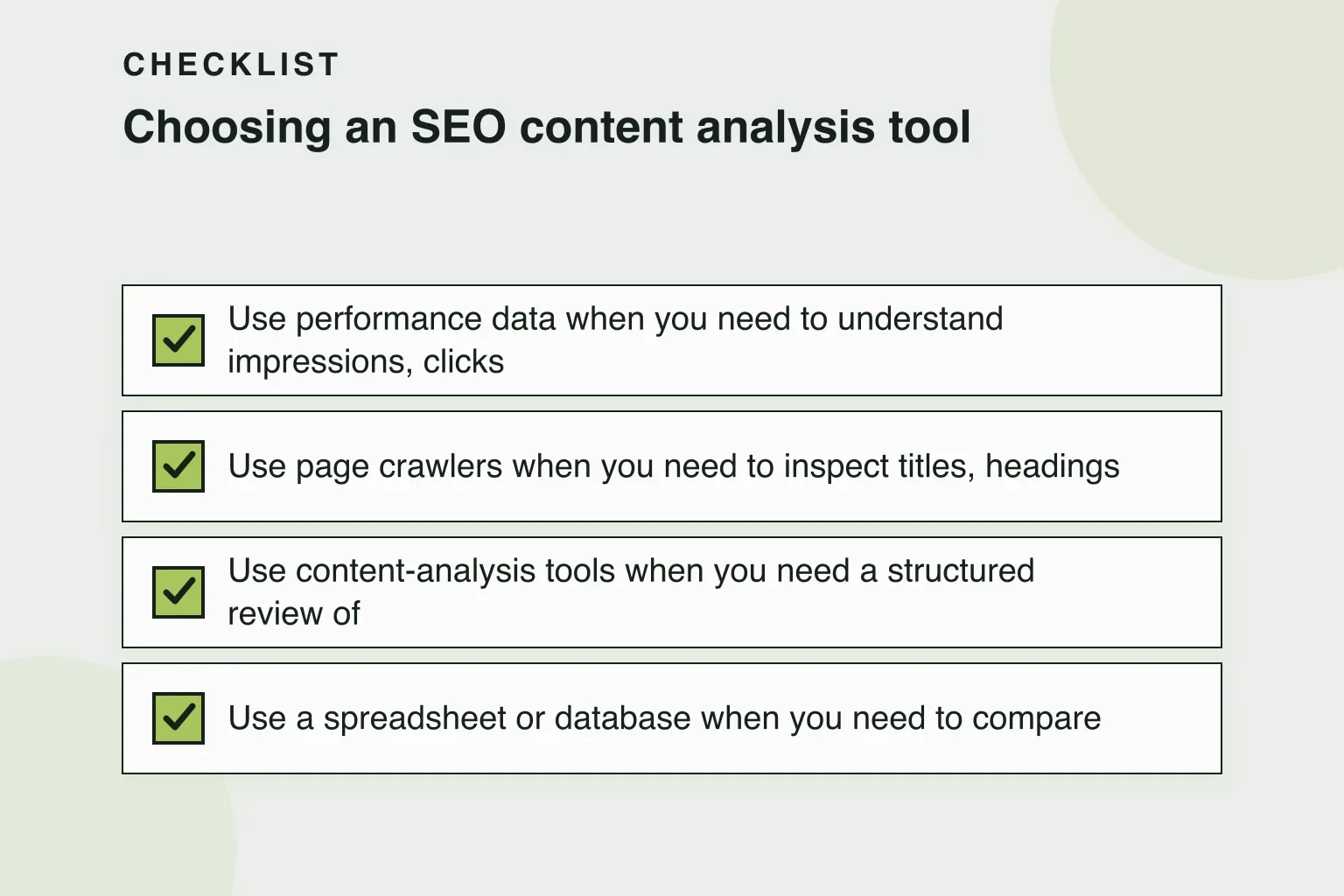
- Use performance data when you need to understand impressions, clicks, and ranking movement.
- Use page crawlers when you need to inspect titles, headings, links, indexability signals, or repeated patterns at scale.
- Use content-analysis tools when you need a structured review of topic coverage, readability, or on-page elements.
- Use a spreadsheet or database when you need to compare recommendations, owners, priorities, and status across pages.
No tool can determine the correct editorial decision in every case. Automated recommendations may not understand brand nuance, audience expectations, business priorities, or why two pages should remain separate. Treat scores as prompts for investigation, not as proof that a page needs a particular word count or keyword frequency.
Resources such as Content Analysis, Real-time Content Analysis with Yoast SEO, and SEO Checker from Seobility illustrate different approaches to content and page review. Compare tools by the evidence they expose, the controls they provide, and how easily their findings can become specific, reviewable work.
Common SEO content audit mistakes
Treating a score as the objective
A page can receive a strong tool score and still fail to answer the searcher’s question. Conversely, a page may fall short of an arbitrary content score while being the clearest result for its audience. Use scoring systems as diagnostic input, then read the page and inspect the evidence.
Rewriting every page
Not every page needs a refresh. Unnecessary rewrites can remove useful detail, create new errors, or cause two pages to become more similar. Preserve pages that already serve a clear purpose unless the evidence supports a change.
Confusing length with completeness
Longer content is not automatically more useful. Add material when it resolves a real question, supports a decision, or improves clarity. Remove repetition when it makes the page harder to use.
Ignoring the wrong ranking page
If the intended URL is not ranking, expanding that URL may not solve the underlying problem. Check for overlapping pages and clarify which page should serve the topic before investing in a large rewrite.
Failing to record the recommendation
A list of issues without a priority, owner, or next step is difficult to act on. Capture the reasoning behind each recommendation so another person can review, approve, or challenge it.
Frequently asked questions
How often should you perform an SEO content audit?
There is no universal schedule. Review important or frequently changing pages when performance shifts, major offerings change, or new content planning raises questions about existing-page fit. A broader audit can be scheduled periodically, but the frequency should match the size and importance of the site.
Is an SEO content audit the same as a content audit?
They overlap, but they are not identical. A general content audit may examine brand alignment, editorial quality, audience usefulness, and business performance. An SEO content audit adds search intent, organic visibility, ranking-page fit, query data, internal linking, and other search-related considerations.
Can an SEO content audit replace an SEO technical audit?
No. Content review can reveal some on-page or linking issues, but it does not replace a technical review of crawling, indexing, performance, structured data, or site architecture.
What should happen after the audit?
Prioritize the recommendations, validate any uncertain assumptions, and send changes through the team’s normal review process. Then monitor the relevant page and query signals after implementation. The RomeoSEO blog includes related guidance, including an anatomy of a blog post for teams planning or reviewing new content.
Final takeaway
A strong SEO content audit connects search evidence to a specific editorial decision. Define the scope, inspect performance and page data, verify intent and ranking-page fit, review the content itself, and document the next action. The best audit is not the one with the most checks or the highest automated score—it is the one that helps a team make a defensible improvement without creating unnecessary work.
If you want to explore an approval-oriented approach to SEO work, go to the RomeoSEO homepage to join the waitlist.