
RomeoSEO10 min read
Best Answer Engine Optimization Tools (2026)
Compare nine answer engine optimization tools for 2026 by engine coverage, pricing, audits and content fixes, and learn how to pick the right one for your site.
TL;DR
There is no single best answer engine optimization tool. The right pick depends on what you need: cheap monitoring, deeper audits, AEO data inside your existing SEO suite, or a platform that also generates and fixes content.
- Otterly.ai: freelancer-friendly monitoring from $29/month, plus GEO audits.
- HubSpot AEO: a low-cost, low-commitment entry at $45 to $50/month, best if you already use HubSpot.
- Peec AI: strong mid-market tracking with sentiment and competitor benchmarking.
- Semrush AI Visibility Toolkit and Ahrefs Brand Radar: AEO data inside SEO suites you may already pay for.
- Profound: enterprise-grade AEO intelligence with prompt volume data and AI agents.
- Scrunch: enterprise monitoring plus content delivery aimed at AI agents.
- AthenaHQ and Writesonic GEO: visibility tracking tied to content publishing and fixes.
No tool on this list guarantees AI citations. Every option below is a monitoring-and-optimization platform; the actual content fixes still happen in your CMS and on your pages.
What an AEO tool actually does
Before picking one, it helps to see where tools sit on a spectrum. Most answer engine optimization products do four things at different depths:
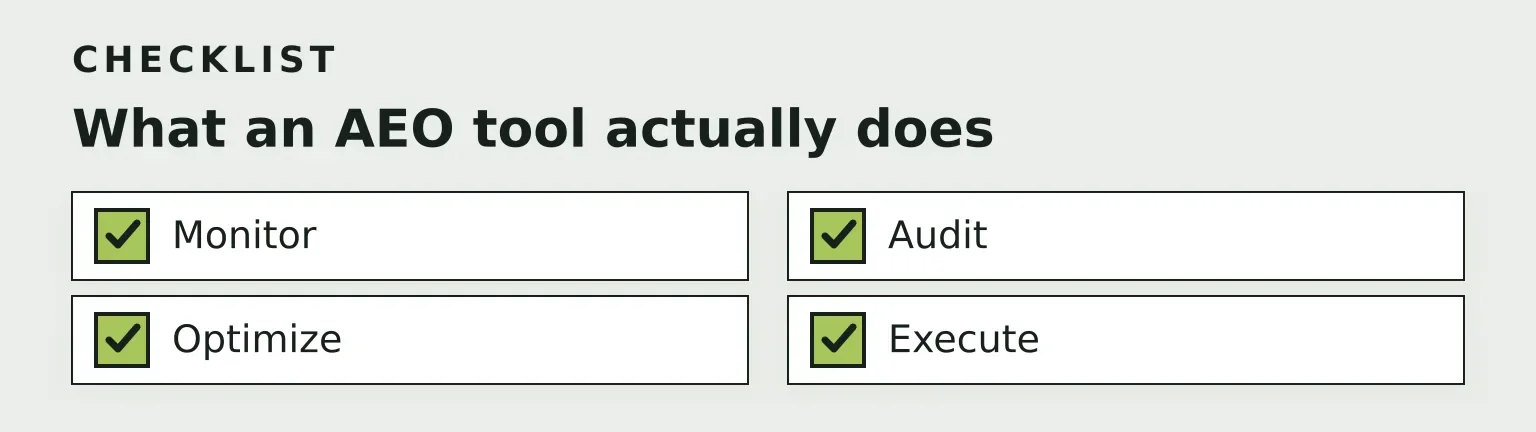
- Monitor: run prompts in ChatGPT, Gemini, Google AI Overviews, Perplexity, Copilot and similar engines, then record whether your brand is mentioned or cited.
- Audit: analyze the pages AI cites and your site's AI readiness, then show the gaps.
- Optimize: recommend or generate content changes to close those gaps.
- Execute: publish those changes, or hand them to a workflow you already have.
Most tools do the first two well. Only some do the last two, and none does the publishing for you unless you hand over that workflow. If you want the full framework for comparing AI search optimization tools by category, the site's guide on how to compare them goes deeper on this.
How to judge these tools
This comparison uses public product documentation and pricing pages, checked on October 27, 2026. It is not a hands-on performance benchmark. We compared the tools below on six criteria:
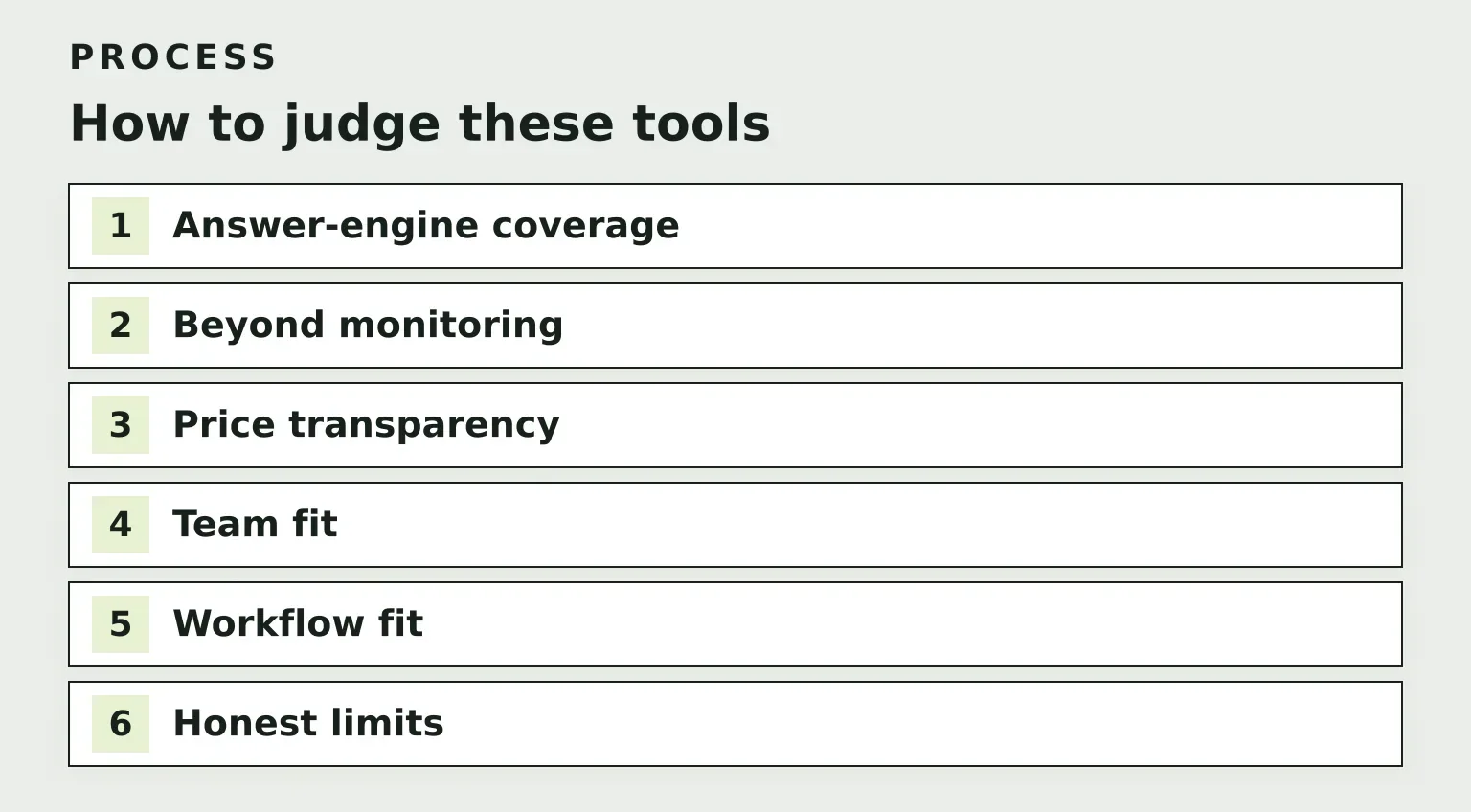
- Answer-engine coverage. Which engines are included at entry price, and which are paid add-ons? Coverage of ChatGPT, Gemini, Google AI Overviews, Google AI Mode, Perplexity, Copilot and Claude varies a lot.
- Beyond monitoring. Does it audit pages, benchmark competitors, and recommend or produce content?
- Price transparency. Is the entry price public, and how fast do costs grow with prompts?
- Team fit. Solo marketer, small team, mid-market, or enterprise?
- Workflow fit. Does the data connect to an SEO suite, CMS or reporting tool you already use?
- Honest limits. What does it clearly not do?
With those criteria set, here are the tools worth shortlisting in 2026.
HubSpot AEO: the budget entry point for SMB teams
HubSpot AEO tracks 25 prompts across ChatGPT, Gemini and Perplexity with a visibility score, citation analysis, competitor share of voice, and prioritized recommendations. A free trial needs no credit card, and ongoing access is $50/month ($45 billed yearly), with no HubSpot subscription required.
Best for: small businesses that want a cheap, low-commitment start. Tradeoff: three engines only, 25 prompts, and no Claude, Copilot or AI Mode. If you outgrow the prompt limits, add-on prompts or a bigger platform become necessary quickly.
Otterly.ai: low-cost monitoring and GEO audits
Otterly.ai starts at $29/month for 15 search prompts with daily tracking across ChatGPT, Google AI Overviews, Perplexity and Copilot. Claude, Gemini and Google AI Mode are add-ons, priced separately. Plans include GEO URL audits (1,000 per month on Lite), sentiment analysis, and citation source tracking, scaling to enterprise plans with SSO and custom terms.
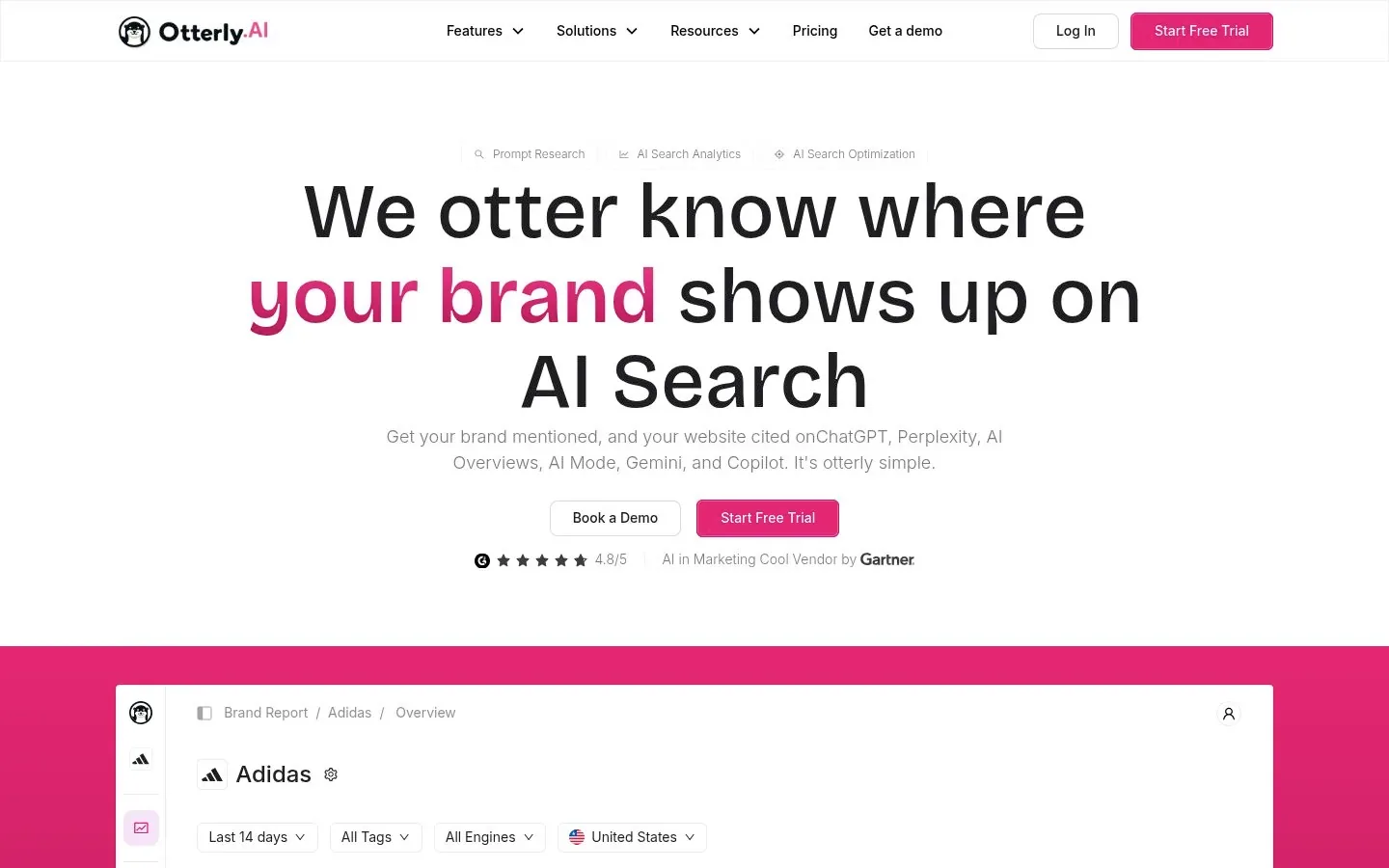
Best for: freelancers and small teams who want daily monitoring and audit data on a tight budget. Tradeoff: engine coverage beyond the base four costs extra, so your real monthly cost depends on which engines matter to you.
Peec AI: mid-market multi-model tracking
Peec AI tracks visibility, position, sentiment and share of voice daily across ChatGPT, Google AI Overviews, Google AI Mode, Copilot, Perplexity and Gemini, with Claude and other models available. Brand plans run from a Starter tier for SEO and content managers up through Advanced and custom Enterprise tiers; agency plans are priced in credits. Starter includes 50 prompts and three selected models. Looker Studio integration starts at Advanced, while API access is listed for Enterprise; engine breadth and reporting depend on the plan.
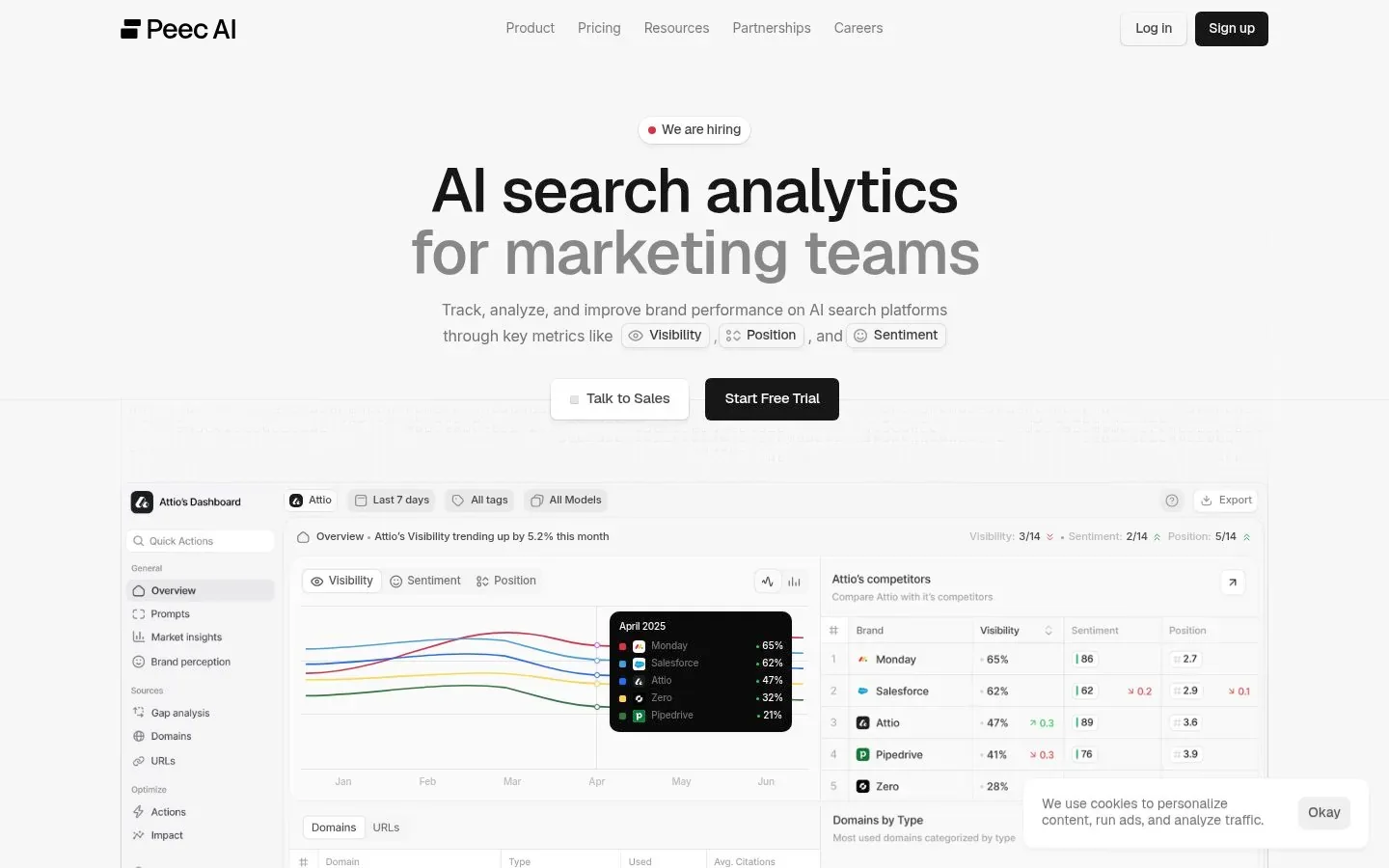
Best for: SEO teams that want competitor benchmarking and sentiment across a selectable engine set. Tradeoff: pricing tiers and prompt volumes change often, and you should confirm current prices on Peec's own pricing page before committing.
Semrush AI Visibility Toolkit and Ahrefs Brand Radar: AEO inside your SEO suite
If you already pay for a major SEO suite, AEO data may be an add-on rather than a new subscription.
Semrush's AI Visibility Toolkit is $99/month per domain, billed annually. It covers mentions from ChatGPT, Google AI, Gemini and Perplexity, 25 daily-tracked prompts, AI competitor analysis, prompt research, and an AI-readiness site audit. Check the current trial terms for this specific toolkit before subscribing.
Ahrefs Brand Radar comes in two modes: custom prompt tracking starts at $50/month and is included with paid Ahrefs Lite plans and above, while the AI Visibility Index, which shows any brand's standing across a large indexed prompt database, starts at $199/month per platform or $699/month for all models. It covers AI Overviews, AI Mode, ChatGPT, Perplexity, Gemini and Copilot, with Claude available on custom prompts.
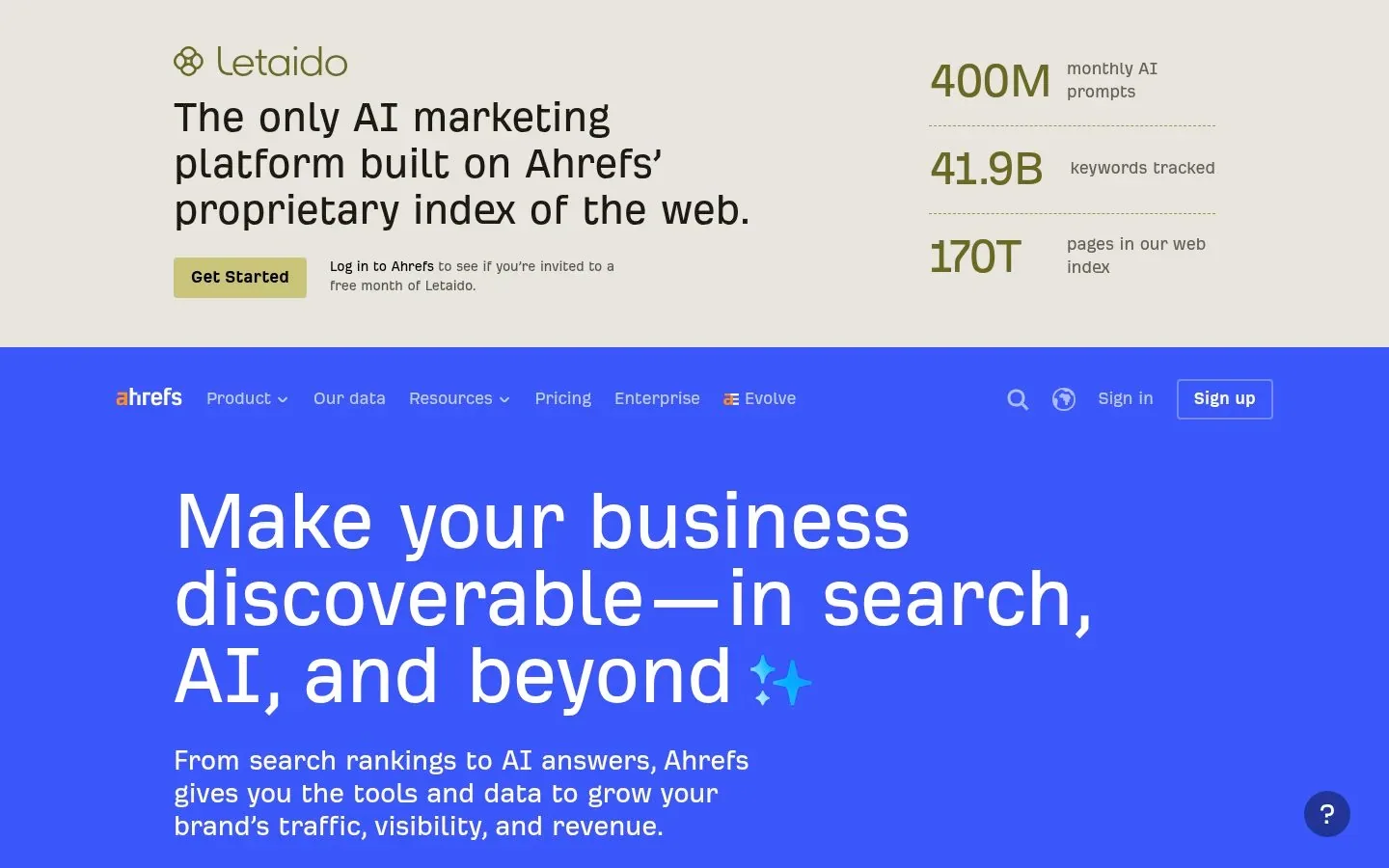
Best for: teams that want AI visibility next to their keyword and backlink data. Tradeoff: both are monitoring-heavy. Recommendations are thinner than in dedicated AEO platforms, and you may still need a separate workflow to act on what they show.
Profound: enterprise AEO intelligence and AI agents
Profound is built for companies operationalizing AI search at scale. It combines Answer Engine Insights with Prompt Volumes, a dataset of real prompts users submit to AI platforms, plus Agent Analytics for AI crawler traffic. Check Profound's pricing page for current packages and request a quote for your engine coverage, prompt volume and agent usage. Confirm security and usage allowances for the package you choose.
Best for: enterprise teams that want prompt volume data and AI-driven content workflows in one platform. Tradeoff: confirm how the quoted package charges for monitoring and agent work before comparing its total cost.
Scrunch: enterprise monitoring plus content delivery to AI agents
Scrunch lists Starter at $250/month billed annually or $300 month to month, with 350 custom prompts, three user licenses and five page audits. Its pricing page lists ChatGPT, Claude, Gemini, Perplexity, Google AI Mode, AI Overviews and Meta coverage. Enterprise adds custom scale, SSO and API access; confirm Agent Experience Platform access separately.
Best for: mid-market and enterprise teams that want an end-to-end monitor-to-optimize platform. Tradeoff: the entry price is several times HubSpot's or Otterly's, so it only makes sense once AI search is a real budget line.
AthenaHQ: tracking tied to content actions
AthenaHQ has a free Essential plan, a $295/month Starter plan covering 11 models including ChatGPT, Perplexity, AI Overviews, AI Mode, Gemini, Claude, Copilot, Grok and more, and custom Enterprise pricing. Starter includes unlimited topics, prompts and competitors, content recommendations and integrations. Confirm access to the advanced content optimization agent, which the plan comparison reserves for Enterprise. Credits, at one per AI response, meter usage.
Best for: SMBs and mid-market teams that want visibility tracking connected directly to on-page and off-page action recommendations. Tradeoff: $295/month is a big jump from the free plan, and heavy agent use will consume credits faster than the monthly allotment suggests.
Writesonic GEO: monitoring plus AI content publishing
Writesonic combines AI search visibility tracking with AI article generation and site audits. Its Starter plan is $79/month billed annually, covering ChatGPT, Gemini and Google AI Overviews with 50 prompts tracked daily, 15 AI articles and 10 site audits monthly. Higher tiers add sentiment analysis, an Action Center, more platforms, and enterprise features like SSO and SOC 2 compliance.
Best for: teams that want to fix visibility gaps by generating content in the same platform they monitor with. Tradeoff: entry-level engine coverage is narrow, and AI-generated articles still need human review to avoid adding thin content to your site.
Pick by your situation
- Solo marketer or very small site, tight budget: Otterly Lite ($29/month) or HubSpot AEO ($45 to $50/month). Start with monitoring; optimize later.
- Small SEO team, want audits and competitor data: Peec AI or Otterly Standard, and check which engines are add-ons before you commit.
- Already on Semrush or Ahrefs: add the AI Visibility Toolkit or Brand Radar before buying a separate tool. The data may already be worth the add-on price.
- Enterprise with a real AI search budget: Profound, Scrunch, or AthenaHQ Enterprise, depending on whether you value prompt volume data, agent experience, or content actions most.
- Need fixes, not just dashboards: Writesonic or AthenaHQ tie tracking to content execution. Pair any monitor with a content workflow, because monitoring alone changes nothing on your site.
A note on that last point: closing a citation gap is usually on-page content work. You find the gap with an AEO tool, then improve the page that should earn the citation. That improvement work is its own discipline, covered in the site's on-page SEO optimization guide, and tools that automate content production are compared separately in these 12 SEO automation tools.
Honest limitations to keep in mind
- No tool guarantees citations. AI engines choose their own sources. Any vendor promising guaranteed AI visibility is overstating what is possible.
- Numbers fluctuate daily. AI answers change run to run, so judge trends over weeks, not single days. HubSpot's own documentation recommends reviewing performance across multiple days or weeks.
- Prompt lists make or break the data. If your tracked prompts do not match what buyers actually ask, your visibility score is measuring the wrong thing.
- Price claims go stale fast. AEO pricing changes constantly, and public roundups disagree on current tiers. Confirm prices on each vendor's own pricing page before you buy.
- Monitoring is not optimization. A dashboard that finds gaps still leaves the writing, publishing and internal linking to you.
That last gap is where RomeoSEO sits. It is not an AEO tracker and does not monitor AI answers. It is the execution step: it uses your pages, rankings and Search Console data to find and prioritize content opportunities, improves existing pages, titles, metadata and internal links, and prepares every change for human review before it goes live. If you want the content side of your AI search work handled through reviewed changes rather than another dashboard, you can join the RomeoSEO waitlist on the homepage with just an email address.
Quick answers
What does an answer engine optimization tool do? It runs prompts in AI platforms such as ChatGPT, Gemini, AI Overviews and Perplexity, records whether your brand is mentioned or cited, and increasingly audits your site and recommends content fixes.
Do AEO tools guarantee AI citations? No. None of the tools listed here can force an AI engine to cite you. They measure visibility and help you improve the content that earns it.
What does AEO tooling typically cost? Public entry plans in this comparison start around $29 to $99 per month. Broader packages can cost several hundred dollars per month, with custom enterprise quotes. Billing terms, engines and response limits affect the total.