
RomeoSEO10 min read
How to Use AI for Content Gap Analysis in SEO
Run an AI content gap analysis step by step: pick an underperforming page, find its ranking terms, compare with higher results, and review the changes.
Summary of the Article
AI makes content gap analysis faster by doing the pattern-finding for you. It can list the terms a page ranks for, scan the pages ranking above it, and report what those pages cover that yours does not. You still make the judgment calls, because AI does not know your business, your customers, or the searcher's real intent. The workflow looks like this:
- Step 1: Pick a page that is losing rankings or stuck below similar results.
- Step 2: Find the terms Google already associates with that page.
- Step 3: Compare the page against the results ranking above it.
- Step 4: Split your findings into parity fixes and original information gain.
- Step 5: Score each finding on business relevance, authority, intent, and effort, not raw search volume.
- Step 6: Make the changes, then route them through human review before they ship.
Run the analysis with AI, then close it with a human decision. The rest of this guide walks through each step and the places where AI-assisted analysis usually goes wrong.
Before you start: three prerequisites
You need three things before an AI SEO content gap analysis produces anything useful.
- Ranking data. Google Search Console is the baseline, because it shows which queries your page actually appears for. A rank-tracking tool works too. If you are setting this up from scratch, our guide to SEO keyword ranking covers what to track and why.
- One chosen page. Gap analysis works page by page. Pick the page first; step 1 shows how.
- A working definition. A content gap is something that keeps your page from competing with the results ranking above it: a missing subtopic, the wrong format, a mismatch with what searchers want. It is not simply "any keyword a competitor ranks for." Tools like Ahrefs define it as keywords competitors rank for that you do not, but not every one of those keywords is worth chasing.
Step 1: Pick the right page to analyze
Do not feed the AI a random page. You get the most from the analysis when the page has something at stake. Good candidates are pages that:
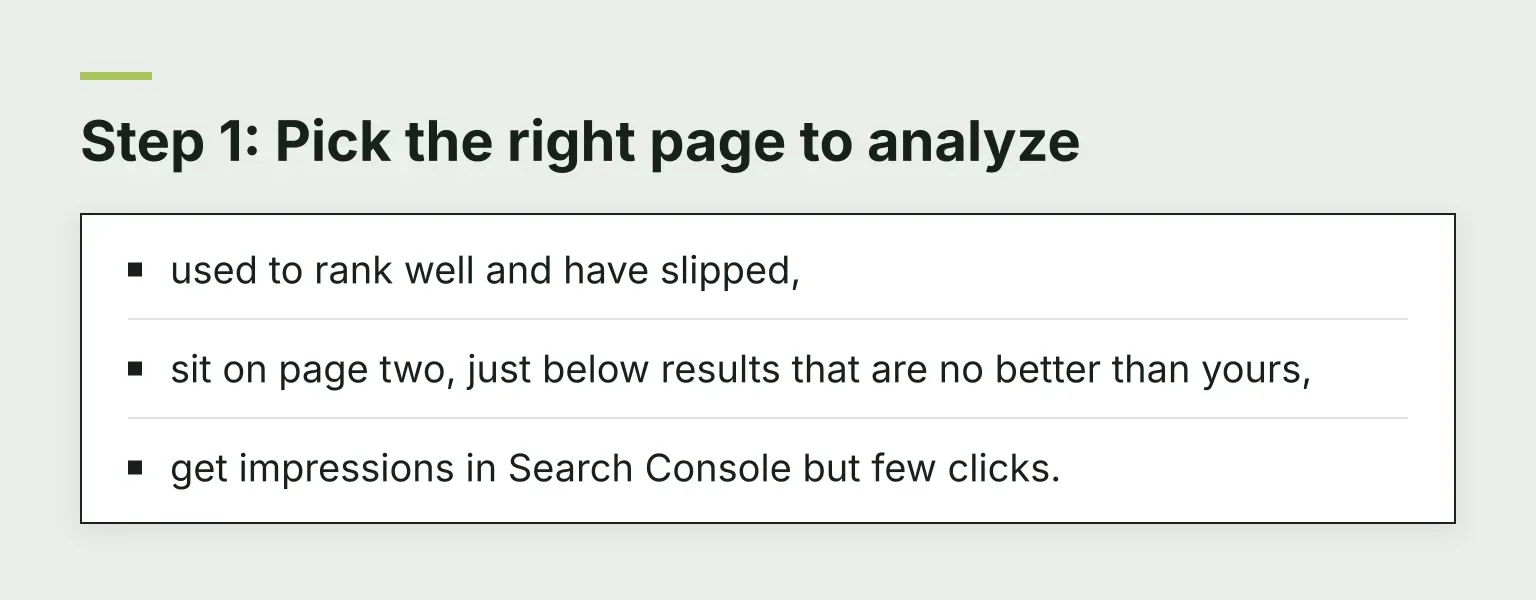
- used to rank well and have slipped,
- sit on page two, just below results that are no better than yours,
- get impressions in Search Console but few clicks.
If you do not know where to start, open Search Console and sort queries by impressions with a position between roughly 8 and 20. The pages behind those queries are the "almost there" cases, and they usually respond to improvement faster than brand-new pages do.
Step 2: Find the terms Google already associates with the page
Every page has a small set of queries it mainly ranks for. Pull those terms from Search Console or from your SEO tool before you compare anything. This matters because Google has already made a judgment about what your page is about. You want to improve that judgment, not confuse it.
Ask the AI (or your tool) for the page's main ranking terms and note roughly where the page stands for each one. Then treat each term as its own mini-analysis in the next step. Ahrefs' content gap guide describes this as the difference between domain-level gaps (topics your whole site is missing) and page-level gaps (a competitor's page on the same topic outranks yours and earns more keywords). This workflow is the page-level kind, which is usually where the quickest wins hide.
Step 3: Compare your page with the pages ranking above it
For each main ranking term, open the results that outrank you. Then have the AI compare, on four axes:
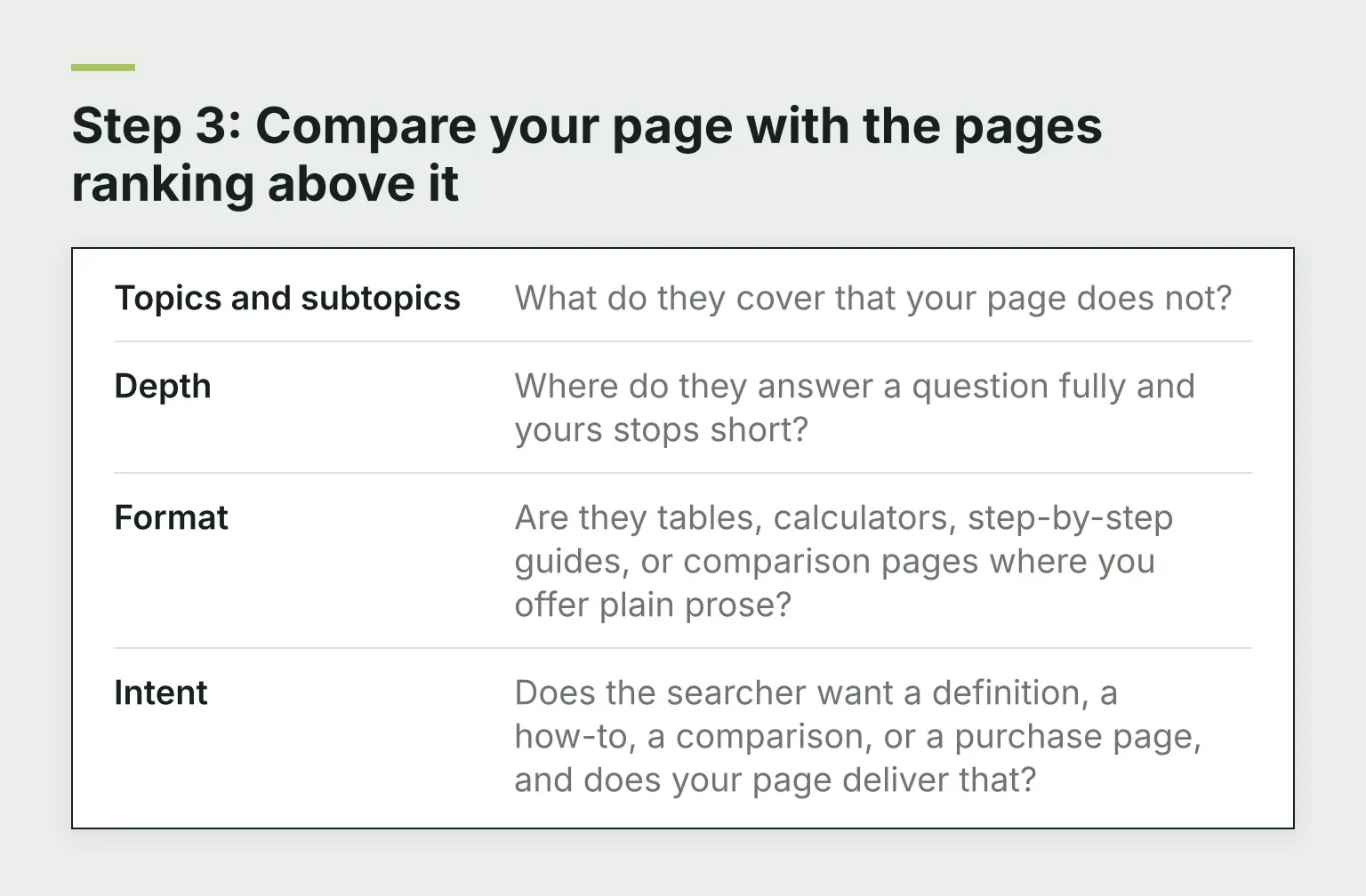
- Topics and subtopics. What do they cover that your page does not?
- Depth. Where do they answer a question fully and yours stops short?
- Format. Are they tables, calculators, step-by-step guides, or comparison pages where you offer plain prose?
- Intent. Does the searcher want a definition, a how-to, a comparison, or a purchase page, and does your page deliver that?
The value of AI here is speed. Reading ten competing pages and building a gap list by hand takes hours; an AI pass over the same material takes minutes. The Ahrefs Academy's content gap walkthrough shows the same logic done with a tool: set the comparison to the exact URL, so you are measuring your page against its real rivals rather than your whole domain.
What the AI hands you at the end of this step is a raw findings list. It is not a to-do list yet, for two reasons. First, some findings will be traps. Second, and more important, not all gaps are the same kind of gap.
Step 4: Separate parity gaps from information gain
This is the step most people skip, and it is where a content gap analysis with AI either becomes strategic or stays a copycat exercise.
Parity gaps are things every page ranking above you covers and yours does not. A missing definition, an outdated section, no pricing example, no comparison table. These are table stakes. Closing them makes your page eligible to compete; it does not make it better than what is already there.
Information gain is the opposite. It is what your page can add that none of the ranking pages have: your own data, first-hand experience, a tested method, a local example, an honest tradeoff nobody mentions. Google's guidance on creating helpful, people-first content asks this directly: does the content provide original information, reporting, research, or analysis, and does it go beyond summarizing other sources?
Sort every finding from step 3 into one of these two buckets before you prioritize anything. A page that fixes parity but adds no information gain usually climbs a few positions and stalls, because it is now identical to the pages above it. A page that adds information gain without fixing parity gives searchers no reason to stay, because the basics are missing.
Step 5: Prioritize with explicit criteria, not raw volume
An AI pass can easily produce 30 findings for a single page. You cannot act on 30. Score them before you touch the page.
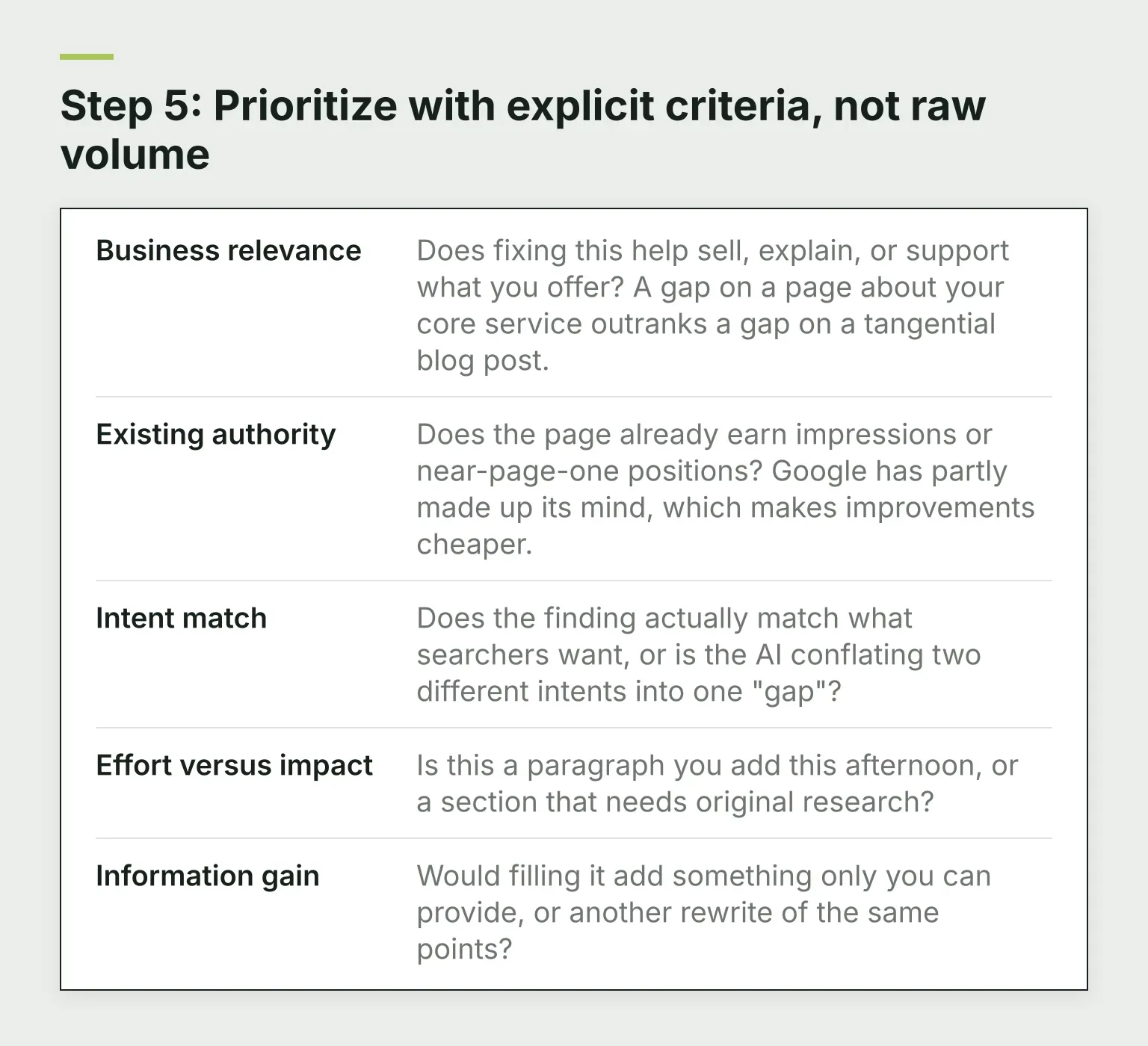
Five questions work well, and search engines' own priorities are a good tiebreaker:
- Business relevance. Does fixing this help sell, explain, or support what you offer? A gap on a page about your core service outranks a gap on a tangential blog post.
- Existing authority. Does the page already earn impressions or near-page-one positions? Google has partly made up its mind, which makes improvements cheaper.
- Intent match. Does the finding actually match what searchers want, or is the AI conflating two different intents into one "gap"?
- Effort versus impact. Is this a paragraph you add this afternoon, or a section that needs original research?
- Information gain. Would filling it add something only you can provide, or another rewrite of the same points?
Search Engine Land's AI-powered gap analysis workflow makes the same point about scoring models: teams gravitate toward the biggest search volume, but a moderate-volume topic that supports the business often beats a high-volume keyword you cannot rank for. Volume belongs in the model, but it should not run it.
Step 6: Turn the top findings into reviewed page improvements
Take the highest-scoring findings and convert them into concrete edits: the exact section to add, the claim to update, the table to build, the internal links to insert. This is normal on-page work, and our on-page SEO optimization guide covers the mechanics of titles, headings, and content structure if you need them.
Two rules keep this honest.
Verify every fact before it ships. AI regularly states things that sound right and are not. Check numbers, product names, and claims against their sources, or cut them.
Keep a human in the loop before anything goes live. Even when the edits are good, a person who knows the business should read the final draft. That is not bureaucracy; it is the difference between an AI-assisted analysis and an AI-run website. RomeoSEO, the tool we build, is designed around this: it prepares improvements to existing pages and hands them to you as reviewable changes through pull requests or CMS drafts, so nothing publishes without a person approving it.
Where a tool like First Page Analyser fits
You can run every step above with Search Console, a spreadsheet, and a chatbot. It just takes longer, especially at step 3, where you read competing pages and build the comparison yourself.
This is the gap RomeoSEO's First Page Analyser is built to close. It researches keywords and identifies content gaps, finds pages that are losing traffic or rankings, prepares improvements to those pages, and packages the changes for human review. The workflow in this article is the manual version of that loop; the tool automates the data-gathering and drafting while leaving the judgment to you.
If you are comparing tools for this kind of work, our guide to choosing an SEO analysis tool lays out what to look for.
Four pitfalls that waste an AI content gap analysis
- Clustering by keyword similarity instead of strategy. AI groups terms that share words, not terms that share a goal. A cluster of near-identical phrases can hide two different intents, and a "different" cluster can serve one intent. Check the search results yourself before trusting any grouping.
- Chasing every visible gap. A complete findings list feels like progress, but acting on all of it produces a bloated page that serves nobody. Prioritize hard, and accept that some gaps stay open.
- Misreading intent. AI can suggest adding a buying guide to a page that ranks for a simple definition, or vice versa, because it pattern-matched the phrasing. Open the SERP and look at what actually ranks before you restructure anything.
- Trusting the output without validation. AI summaries of competing pages can miss the page's actual point or invent a weakness. Spot-check a few claims against the real pages, always.
What this analysis cannot tell you
No amount of data can answer which gaps matter for your business. The AI does not know your margins, your customer's real questions, or which topic positions you for the work you actually want. It also does not know your voice, which is why unreviewed AI drafts tend to read like everyone else's.
Keep the scope honest in another way too: a gap in Google results is not automatically a gap at all. A page can rank in traditional search and still be absent from AI-generated answers, and that is a separate visibility problem that this workflow does not solve. Fix the search gaps first, then measure whether AI answer engines pick the page up.
After the changes ship: measure, then re-run
A gap analysis only pays off if you check the outcome. Give the changes a few weeks, then look at whether the page's positions and impressions moved for its main ranking terms. Our guide to tracking and improving keyword rankings covers how to read that movement without overreacting to normal fluctuation.
Then re-run the comparison from step 3. If the page now covers what the ranking pages cover and adds something they do not, and it still does not move, the problem is usually authority or competition, not content, and more editing will not fix it. When you want to widen the lens from one page to your whole site, a full SEO content audit is the natural next step.
If you want this loop running on your site, with the findings prepared as reviewable changes instead of another spreadsheet, join the RomeoSEO waitlist.