
RomeoSEO8 min read
GEO vs SEO vs AEO: What's the Difference?
GEO, SEO, and AEO explained in plain English: what each targets, how they overlap, how each is measured, and a practical combined strategy for small teams.
Summary of the Article
GEO, SEO, and AEO are three names for getting found in three different places. SEO targets Google rankings, GEO targets citations inside AI chat answers, and AEO targets featured snippets and direct-answer boxes. They are not competing tactics; they are one strategy layered over the same content.
- SEO: still the base. It gets you rankings, clicks, and the crawlable content that AI answers draw on.
- GEO (generative engine optimization): earns mentions and citations inside AI-generated answers from tools like ChatGPT and Google's AI Overviews.
- AEO (answer engine optimization): wins featured snippets, voice answers, and other direct-answer surfaces where one page gets quoted.
- If you are a small team: do SEO first, then add AEO and GEO by restructuring pages you already have. You do not need three separate programs.
What Each One Actually Means
The three acronyms get tossed around as if they were rivals. They describe different surfaces where people find answers:
- SEO (search engine optimization): getting your pages to rank on Google and Bing, and earning the clicks from those rankings.
- GEO (generative engine optimization): getting your site cited inside AI-generated summaries and chatbot answers. The term comes from a 2023 Princeton-led research paper that framed generative engines as search systems that synthesize multiple sources into one response (the GEO paper on arXiv).
- AEO (answer engine optimization): getting your content quoted as the answer itself, in featured snippets, People Also Ask boxes, and voice assistant replies.
The practical difference is where the work shows up. SEO puts a link to your page on a results page. GEO puts your site's name inside a paragraph the AI wrote. AEO makes your page the answer box.
SEO: The Foundation That Still Matters
Search engine optimization is the discipline most people know: keyword research, quality content, internal links, technical health, and authority building so pages rank in Google's organic results.
What has changed is not that SEO stopped working. It is that ranking is no longer the whole job.
AI answers need sources. Google's AI Overviews pull from indexed web pages, and chatbots like ChatGPT browse and cite the open web. If your site is hard to crawl, unclear, or has no authority, you lose twice: no rankings, and no chance of being cited by AI. AI Overviews appear on a subset of queries where generative answers add value, and their share of results has hovered in the low double digits of tracked searches (Semrush's AI Overviews study tracked it between about 6% and 25% of keywords during 2025).
So SEO still controls the things GEO and AEO depend on: crawlability, clear content, and trust signals. Skip it and the other two have nothing to stand on.
GEO: Earning Citations Inside AI Answers
Generative engine optimization is about being part of the answer the AI writes. When someone asks ChatGPT "what's the best free rank checker," you want your brand named, quoted, or linked in the response.
What tends to work, based on the early research and practitioner consensus:
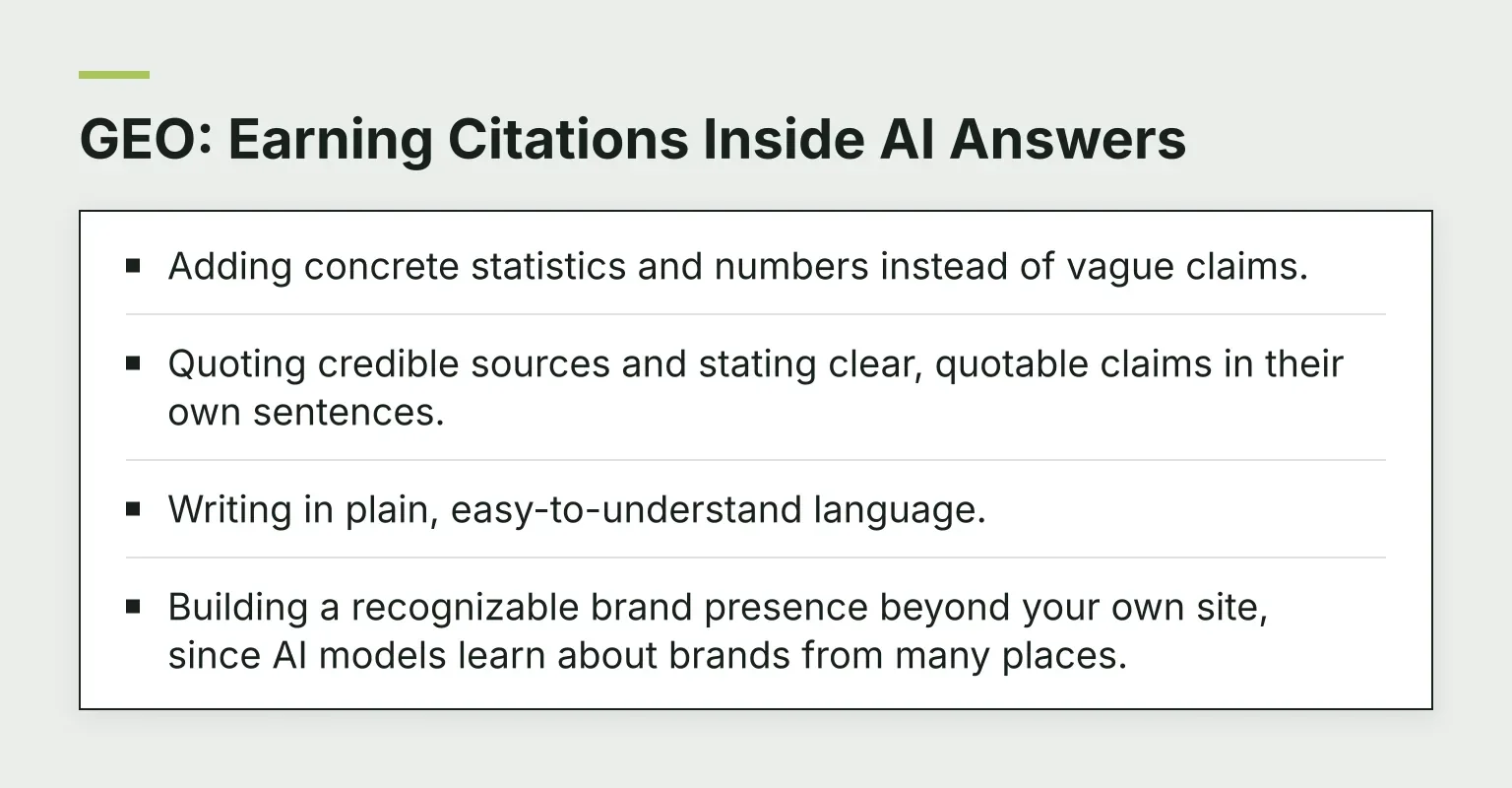
- Adding concrete statistics and numbers instead of vague claims.
- Quoting credible sources and stating clear, quotable claims in their own sentences.
- Writing in plain, easy-to-understand language.
- Building a recognizable brand presence beyond your own site, since AI models learn about brands from many places.
The Princeton paper found that methods like adding statistics and quotations could boost visibility in generative responses meaningfully (the paper reported gains of up to 40% in its test framework), though the effect varies by topic area.
How you measure GEO is different too. There is no "position 3" inside a chat answer. You track whether your brand appears in answers to your key questions, how often, and how prominently. That is what makes AI search visibility its own practice; if you want the mechanics, our guide on AI search monitoring covers how to track your AI visibility.
AEO: Winning the Direct Answer
Answer engine optimization predates the AI chat boom. It is the craft of structuring a page so an engine can lift one clean answer out of it: featured snippets, People Also Ask, voice replies.
AEO tactics are concrete:
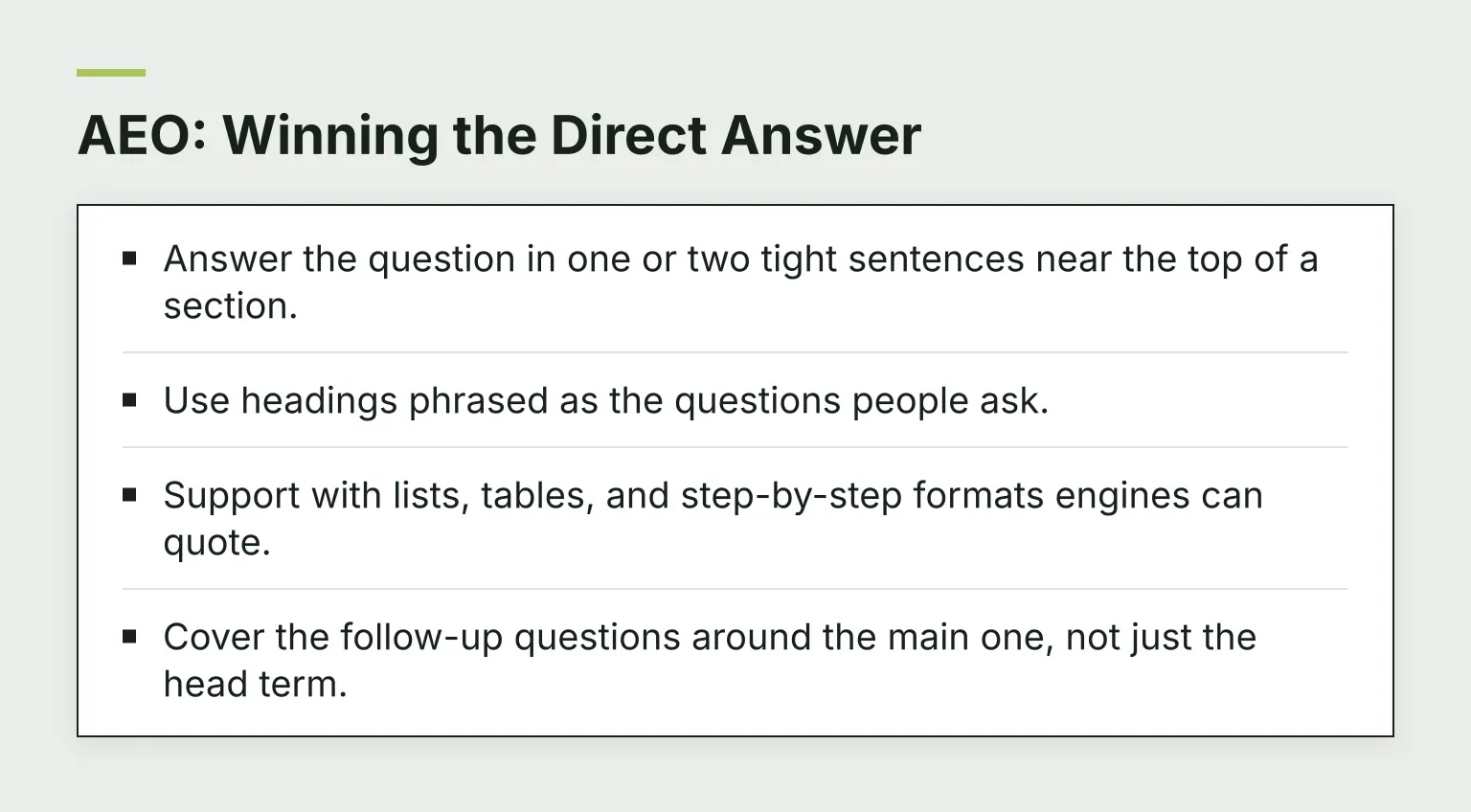
- Answer the question in one or two tight sentences near the top of a section.
- Use headings phrased as the questions people ask.
- Support with lists, tables, and step-by-step formats engines can quote.
- Cover the follow-up questions around the main one, not just the head term.
The main tradeoff: an AEO win often means the engine answers the question without a click. It is brand visibility and authority building more than direct traffic.
Where They Overlap and Where They Diverge
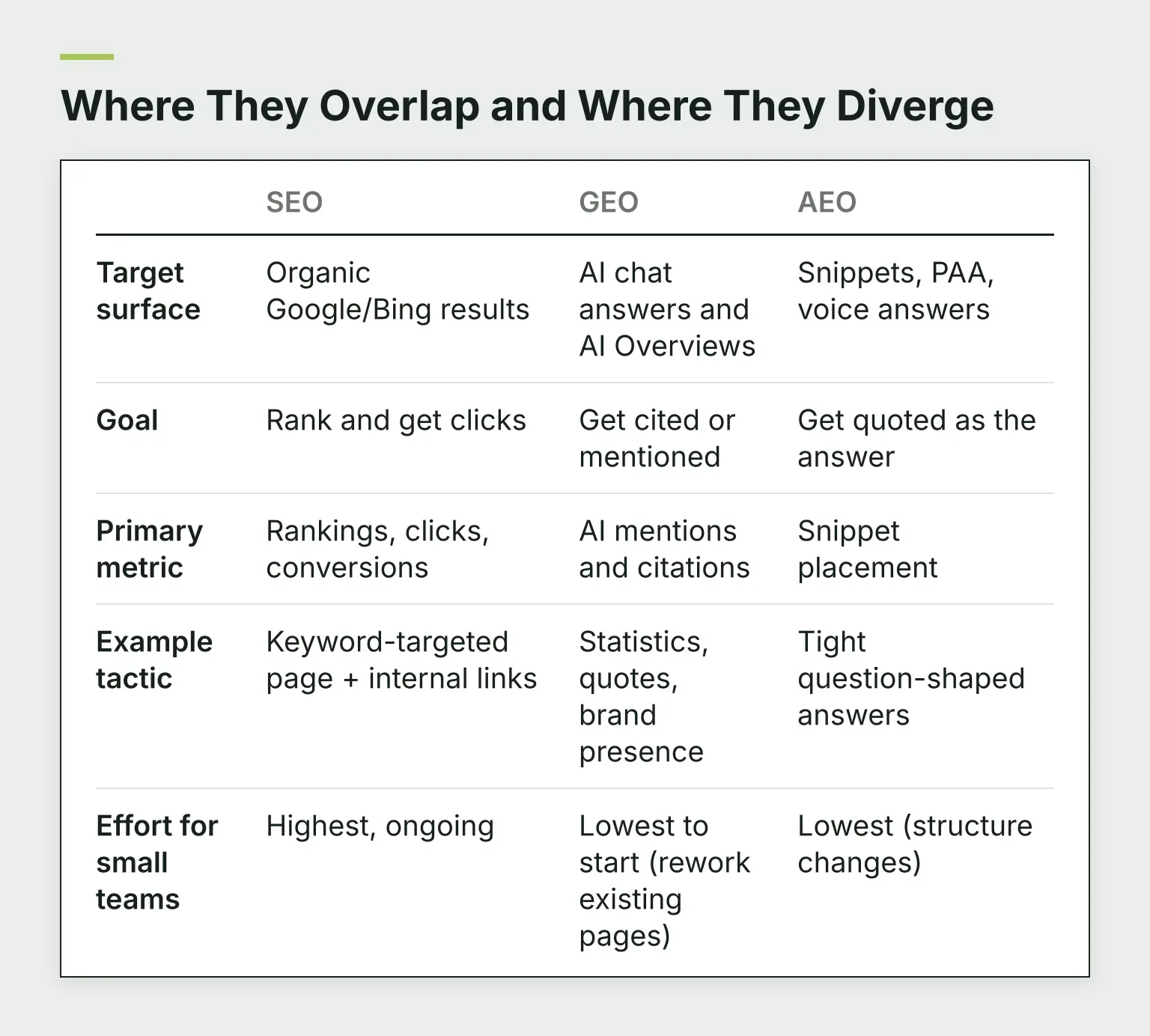
| SEO | GEO | AEO | |
|---|---|---|---|
| Target surface | Organic Google/Bing results | AI chat answers and AI Overviews | Snippets, PAA, voice answers |
| Goal | Rank and get clicks | Get cited or mentioned | Get quoted as the answer |
| Primary metric | Rankings, clicks, conversions | AI mentions and citations | Snippet placement |
| Example tactic | Keyword-targeted page + internal links | Statistics, quotes, brand presence | Tight question-shaped answers |
| Effort for small teams | Highest, ongoing | Lowest to start (rework existing pages) | Lowest (structure changes) |
The overlap is the important part. All three need crawlable pages, clear writing, and genuine authority. That is why the honest answer to "which do you need" is: the same work, read three ways.
Measurement is where the split becomes real. For SEO you watch rankings, clicks, and conversions in tools like Search Console. For GEO you watch whether AI tools name or cite you, which needs its own tracking. For AEO you watch whether a specific page holds the answer box. Same content, three different dashboards.
The Terminology Trap (Read This Before You Buy Anything)
Be careful with these acronyms, because the industry has not settled on meanings:
- GEO also means geo-targeting. Plenty of articles use GEO for location-based targeting and local SEO. That is a completely different discipline sharing the same letters.
- AIO, AEO, and GEO get used interchangeably. Some sources call AI-answer optimization AIO (AI optimization) or fold it into AEO. SGE was Google's old name for AI Overviews and still shows up in older articles.
- Definitions vary by source. No canonical dictionary exists yet. When a vendor says you urgently need "AEO services," ask which specific surface they mean and how they measure it.
If an article or pitch does not define its terms, that is your cue to question it.
A Practical Combined Strategy for Small Teams
You cannot run three programs. You do not need to. Here is a priority order that works:
- Build the SEO base. Pick the pages that matter, make them crawlable and clear, fix technical issues, and connect Search Console data so you know what to fix first. This is 80% of the value.
- Add AEO structure to existing pages. For your key questions, add short, direct answer paragraphs and question-shaped headings. This is an editing task, not a new content program.
- Layer GEO on the same pages. Strengthen claims with numbers and citations, then check whether AI tools mention you. Start with a free check like our AI Answer Readiness Checker, which tests whether AI is likely to quote your pages.
Notice that each layer reuses the previous one. One page, three surfaces.
Honest Tradeoffs: When SEO-Only Is Enough
- If your customers search Google and click links, and AI Overviews rarely show for your queries, SEO alone may carry you for now.
- GEO measurement is noisy and early-stage. Do not let a new acronym distract you from fixing pages that already rank 5 to 15 for money keywords.
- AEO wins without clicks still have value (brand recognition), but if you need leads this quarter, prioritize rankings over snippet chasing.
- The reverse also holds: if your buyers increasingly ask AI tools for recommendations, being invisible in chat answers is a real risk worth addressing this year.
Frequently Asked Questions
Is SEO being phased out?
No. SEO is changing, not disappearing. Google still sends enormous traffic, and AI answers depend on crawled web content. What is fading is the assumption that one blue link is the only outcome worth pursuing.
Which one is the paid one?
None of them. SEO, GEO, and AEO are all organic disciplines. Paid ads (SEM) are a separate channel. If someone sells you "GEO" as a paid placement in AI answers, be skeptical: you cannot buy citations in most AI tools the way you buy ad slots.
Should I split my budget 80/20 between SEO and AI optimization?
There is no universal ratio. A reasonable small-team default is to spend most of your effort on SEO fundamentals and treat AEO/GEO as formatting and monitoring layers on content you already have.
Where do I start if I have no time?
Fix your best existing pages first: make them crawlable, answer your main customer questions in tight sections, and check whether AI tools can see your site. Our free SEO and AI search skills library includes step-by-step skills for exactly this, and our blog has guides for small sites doing this work without a big team.
Next Step
If this list feels familiar: rankings slipping, AI tools ignoring your site, no time for a big agency program, that is the problem RomeoSEO is built for. It uses your pages, rankings, and Search Console data to find keyword and content opportunities, then writes new articles and improves existing pages, each researched against what already ranks on Google. Start your free trial on romeoseo.com and pick the first page you want to improve.