
RomeoSEO9 min read
Semrush vs Ubersuggest: When the Budget Tool Wins
Can $29-a-month Ubersuggest replace Semrush? A job-by-job look at pricing, rank tracking, backlinks, audits and AI visibility, with a pick for each site size.
Summary of the Article
Ubersuggest covers the core SEO jobs of a single small site at $29 a month, while Semrush earns its higher price with daily rank tracking, deeper competitor data, and room for more projects. If you run one site with modest goals, the budget tool is usually enough. If you manage several brands or need client-grade reporting, you will feel Ubersuggest's limits fast.
- Ubersuggest: $29-$99 per month, or a one-time $290-$990 lifetime plan. Weekly rank tracking on 125-300 keywords, smaller data caps, one straightforward workflow.
- Semrush: $139-$299 per month across three listed tiers, plus a custom-priced Advanced tier. Daily tracking on 500-5,000 keywords, 5-40 monitored sites, and much deeper keyword, backlink, and competitor data.
- Budget middle path: Ubersuggest plus free tools like Google Search Console often beats paying for a premium suite you barely use.
Most comparisons stop at feature lists. This one walks through the actual jobs a small site needs done each month and marks each one: does Ubersuggest handle it, or will you hit the ceiling?
Prices and plan limits below were checked on each vendor's own pricing pages in November 2026. Both companies change plans often, so confirm current numbers on their sites before you buy.
Pricing at a Glance (November 2026)
| Ubersuggest | Semrush | |
|---|---|---|
| Monthly plans | $29 / $49 / $99 (Individual / Business / Enterprise) | $139 / $199 / $299 (SEO / Starter / Pro+), Advanced priced by sales |
| Annual billing | $192 / $326 / $657 per year | Up to 17% off monthly rates |
| One-time option | $290 / $490 / $990 lifetime, non-refundable | None |
| Trial | 7 days on monthly plans | Check the pricing page for current trial terms |
| Tracked keywords | 125-300, refreshed weekly | 500-5,000, tracked daily |
| Monitored sites | Depends on plan; check the pricing page | 5-40 |
| API access | No API plan | Advanced tier |
Two things worth pausing on. First, the lifetime plan looks tempting but is non-refundable, so only buy it once you have used the tool on a monthly plan and know it fits. Second, Semrush recently renamed its plans away from the old Pro/Guru/Business labels, so ignore older articles that quote tier names; check the live pricing page.
Ubersuggest: What $29 to $99 a Month Buys
Ubersuggest is built around one simple idea: give a small site the essential SEO jobs in one place, without a suite of modules you will never open.
On the monthly plans, $29 gets you the Individual tier, $49 the Business tier, and $99 the Enterprise/Agency tier. Small add-ons, such as extra locations, cost around $5 a month. Yearly billing ($192, $326 and $657 a year) cuts the cost further. Details live on Ubersuggest's own pricing page.
What that money covers well:
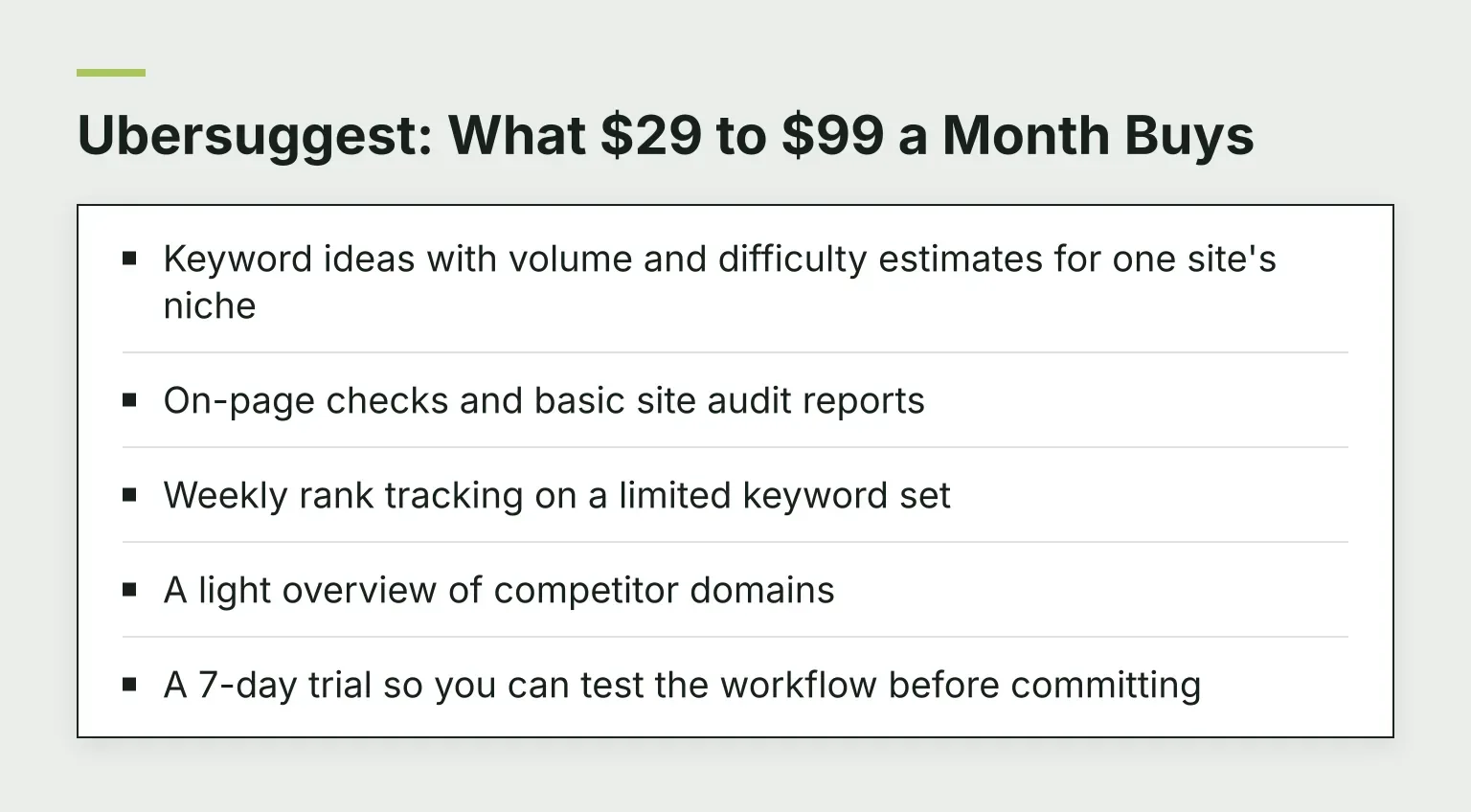
- Keyword ideas with volume and difficulty estimates for one site's niche
- On-page checks and basic site audit reports
- Weekly rank tracking on a limited keyword set
- A light overview of competitor domains
- A 7-day trial so you can test the workflow before committing
The tradeoffs are the caps. Rank tracking refreshes weekly rather than daily, tracked keyword counts sit between 125 and 300, backlink reports cap out in the low thousands of rows, and site audits limit how many pages each crawl covers. For a site with a few hundred pages and a short must-rank list, those caps rarely bite. Past that, they do.
Semrush: What the Premium Price Buys
Semrush is a full toolkit, and its pricing reflects that. Semrush's pricing page lists SEO, Starter and Pro+ tiers from $139 to $299 per month, plus an Advanced tier priced through sales, with up to 17% off if you pay annually.
What the higher price buys:
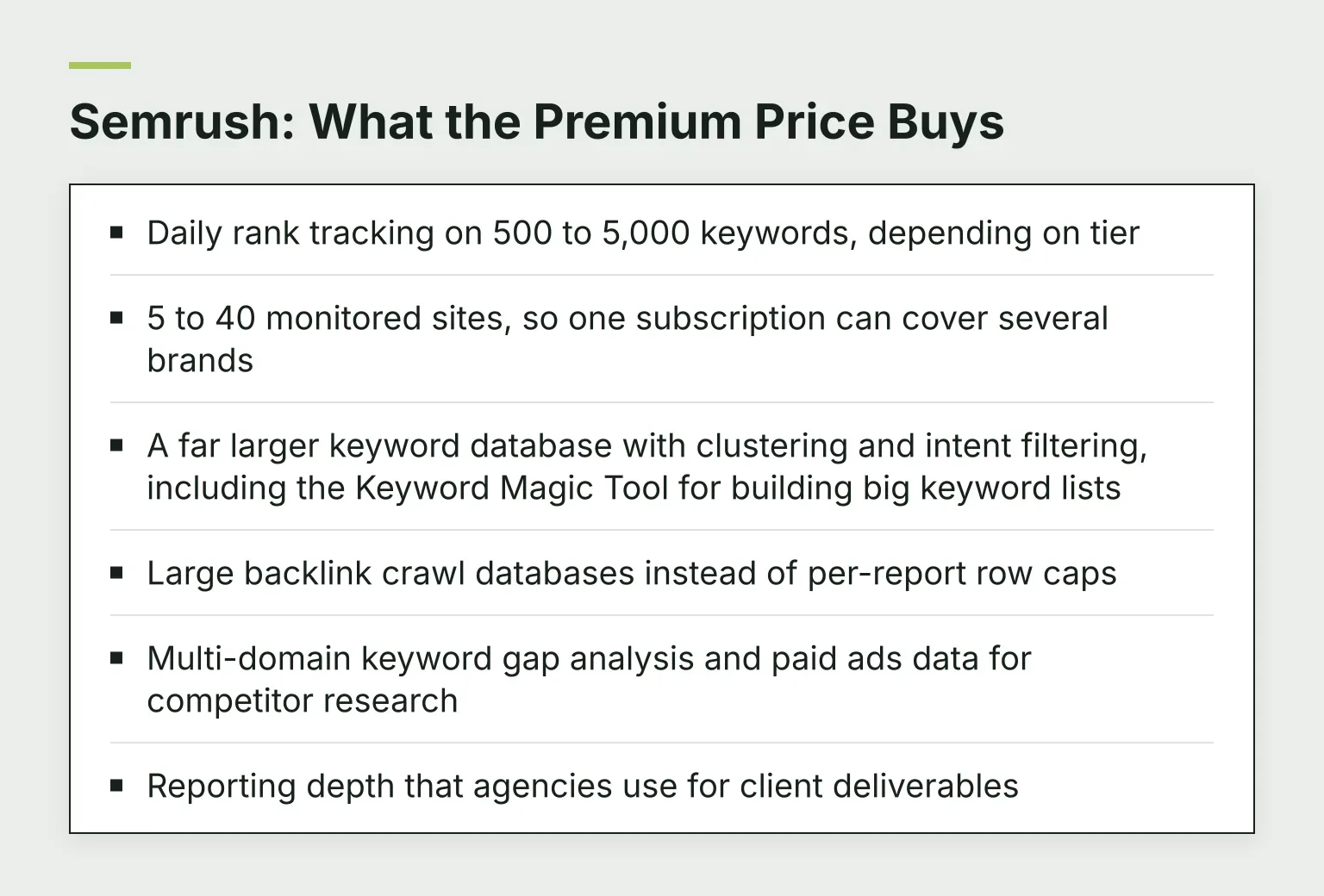
- Daily rank tracking on 500 to 5,000 keywords, depending on tier
- 5 to 40 monitored sites, so one subscription can cover several brands
- A far larger keyword database with clustering and intent filtering, including the Keyword Magic Tool for building big keyword lists
- Large backlink crawl databases instead of per-report row caps
- Multi-domain keyword gap analysis and paid ads data for competitor research
- Reporting depth that agencies use for client deliverables
The honest downside: a lot of that breadth goes unused. If you run one site and never touch ads data or multi-domain gap analysis, you are paying a premium price for capabilities you will not open.
Job by Job: Where the Tools Diverge
Here is the same comparison as a checklist of monthly SEO jobs:
| Job | Ubersuggest | Semrush |
|---|---|---|
| Keyword research for one site | Handles it | Handles it, with more depth |
| Rank tracking | Weekly, 125-300 keywords | Daily, 500-5,000 keywords |
| Backlink checks | Small row caps per report | Large crawl database |
| Site audit | Enough for a small site | More pages and projects per crawl |
| Competitor research | Light domain overview | Keyword gap, ads data, multi-domain |
| AI search visibility | Present, still evolving | Present, still evolving |
Keyword research
For one site, both tools answer the questions that matter: which keywords have demand, how hard they look to rank for, and what variants exist. The numbers are estimates on both platforms, so treat any volume figure as a rough signal, not a fact.
Semrush pulls ahead when research becomes a production job: building lists of hundreds of keywords, clustering them into topic groups, and filtering by search intent. A blogger researching ten new posts a month will not miss that. A content team planning a quarter of work will.
Rank tracking
This is usually the first place Ubersuggest's limits bite. Weekly updates on up to roughly 300 keywords are fine when your must-rank list is short. It becomes a problem when you track a large page inventory or need to spot a ranking drop the day it happens rather than a week later.
If you only track a handful of terms, you may not need to pay anyone: Google Search Console shows your real rankings for free. Our guide on how to track keyword rankings in Search Console walks through the setup.
Backlink data
Ubersuggest caps backlink reports at roughly 2,000 to 10,000 rows depending on plan. For checking your own small link profile or peeking at a competitor's top links, that is plenty. When row caps stop mattering is simple: they stop mattering when you are not doing deep link prospecting. Most small sites are not.
Site audits
A small site needs an audit to find broken pages, missing titles, slow pages, and mobile problems. Ubersuggest covers that, with a cap on pages per crawl. Check the current cap on the pricing page; if your site fits under it, the audit job is handled. Semrush audits larger inventories and supports more concurrent projects, which matters mainly once you are past a few hundred pages or run several sites.
Competitor analysis
Ubersuggest gives you a workable overview of a competitor domain: top pages, main keywords, rough traffic. Semrush lets you compare several domains at once, find the keywords competitors rank for that you do not, and see what they spend on ads. If competitor research drives your strategy, this gap is real. If you mainly want to know who ranks above you for your top terms, it is not.
AI search visibility
Both vendors have added features that estimate how visible a site is in AI answers from tools like ChatGPT and Google's AI Overviews. Treat this category with caution in both directions: it is new, the metrics are not standardized, and features change fast. Verify what each tool actually measures on its live site before you let this line item influence a purchase.
What You Give Up With Either Choice
Choosing Semrush costs money you may not need to spend. Much of its breadth, from ads data to multi-domain gap analysis, sits unused in a typical small-site account.
Choosing Ubersuggest means accepting smaller databases, weekly tracking, and per-report caps. Two cautions deserve special mention:
- The lifetime plans are non-refundable. Test on a monthly plan first.
- If you sign in with Google, think carefully before sharing one login across a team; you are handing collaborators access tied to your Google identity.
Pick by Site Size and Goals
- One-site blogger or side project: Ubersuggest Individual at $29 a month covers your jobs, or skip subscriptions entirely with the free stack below.
- Small business with 2-7 sites or brands: Ubersuggest Business at $49 works if weekly tracking and light competitor data suffice. Step up to Semrush (from $139 a month) when you need daily tracking or deeper competitor research.
- Agency or multi-client work: Semrush's higher tiers. Client reporting, daily tracking at scale, and monitored-site counts are exactly what the premium price pays for.
If you have decided you want a premium suite but are not settled on Semrush, compare the big three in Semrush vs Ahrefs vs Moz: Pick Your First SEO. And if neither of these two feels right, our roundup of the 11 best Semrush alternatives in 2026 covers a wider field.
The Budget Stack: When Free Tools Beat Both
Before paying either subscription, price out this combination:
- Google Search Console for real ranking and click data, free at search.google.com/search-console
- A free keyword research tool for volume and difficulty estimates
- Free checkers for on-page issues, audits, and rank positions
- Ubersuggest's 7-day trial when you need a burst of competitor data
For a small site, this stack covers most monthly jobs at close to zero cost, with Ubersuggest filling the gaps Search Console cannot. Our guide to SEO solutions for small business compares more budget options. Pay for Semrush when the jobs, not the habit of subscribing, demand it.
Common Questions
Can Ubersuggest replace Semrush for a small site?
For one site with a short keyword list and simple audits, yes, mostly. The gaps that matter are daily rank tracking, deep competitor research, and large backlink crawls. If those are not your jobs, Ubersuggest handles the rest.
Is the Ubersuggest lifetime plan worth it?
Only if you have already used the tool and know it fits your workflow. The $290-$990 one-time prices are non-refundable, so treat the lifetime option as a commitment, not an experiment.
Is Ubersuggest good enough in 2026?
For its target user, yes: a solo site owner who needs research, tracking, audits, and a competitor overview in one affordable place. It stops being enough when scale, cadence, or client reporting outgrow its caps.
Next Step
Whichever tool you pick, research is only half the job. The other half is turning findings into pages that actually ship: new articles, updated titles, better content, and internal links. RomeoSEO does that part. Romeo researches each article against live Google results, checks your existing pages first, and improves the pages your Search Console data shows are close to winning. Start your free trial and see what he finds on your site.