
RomeoSEO12 min read
Semrush vs Ahrefs (2026): Honest Comparison
Semrush vs Ahrefs compared job by job: keyword research, audits, rank tracking, AI visibility, and pricing math by team size, with a clear best-fit verdict.
Summary of the Article
Semrush and Ahrefs are both full SEO suites, and neither wins everything. The right pick depends on the job you do most: Semrush is broader and bundles more tools per plan, while Ahrefs leans on its backlink index, cleaner interface, and simpler plan ladder.
- Semrush: best if you want keyword research, audits, rank tracking, and reporting in one broad suite; expect more limits per plan and paid add-ons.
- Ahrefs: best if backlink research and a focused toolkit matter most; Rank Tracker updates weekly by default, which matters if you watch rankings daily.
- Pricing: Semrush's entry SEO plan costs $139.95 per month; Ahrefs' equivalent tier, Lite, is $129. Both add extra seats and AI-visibility features as paid extras.
- Best fit: solo practitioners often get more from Ahrefs Lite; agencies and teams that need broad client reporting in one bill lean Semrush.
- The shortcut: if what you actually want is the outcome (rankings watched, issues fixed, pages improved), RomeoSEO does much of the work you'd otherwise do inside Semrush or Ahrefs for you, at roughly half the price of either suite. The next section covers that done-for-you option.
If Moz is also on your shortlist, our Semrush vs Ahrefs vs Moz comparison covers all three for a first SEO tool.
Why compare Semrush and Ahrefs by the job, not the feature list
Most Semrush vs Ahrefs articles compare feature grids. That gets you nowhere, because both tools check almost every box. What actually differs is how well each one does the specific job you'll do this week: picking keywords, fixing site problems, tracking rankings, watching AI search visibility, and turning all of it into changes on your site.
This article walks through each job, then converts the differences into pricing math for solo practitioners, small teams, and agencies. Prices were checked on each vendor's own pricing page in October 2026 and may change, so treat every figure below as a starting point, not a quote.
The shortcut: what you use Semrush and Ahrefs for, done for you
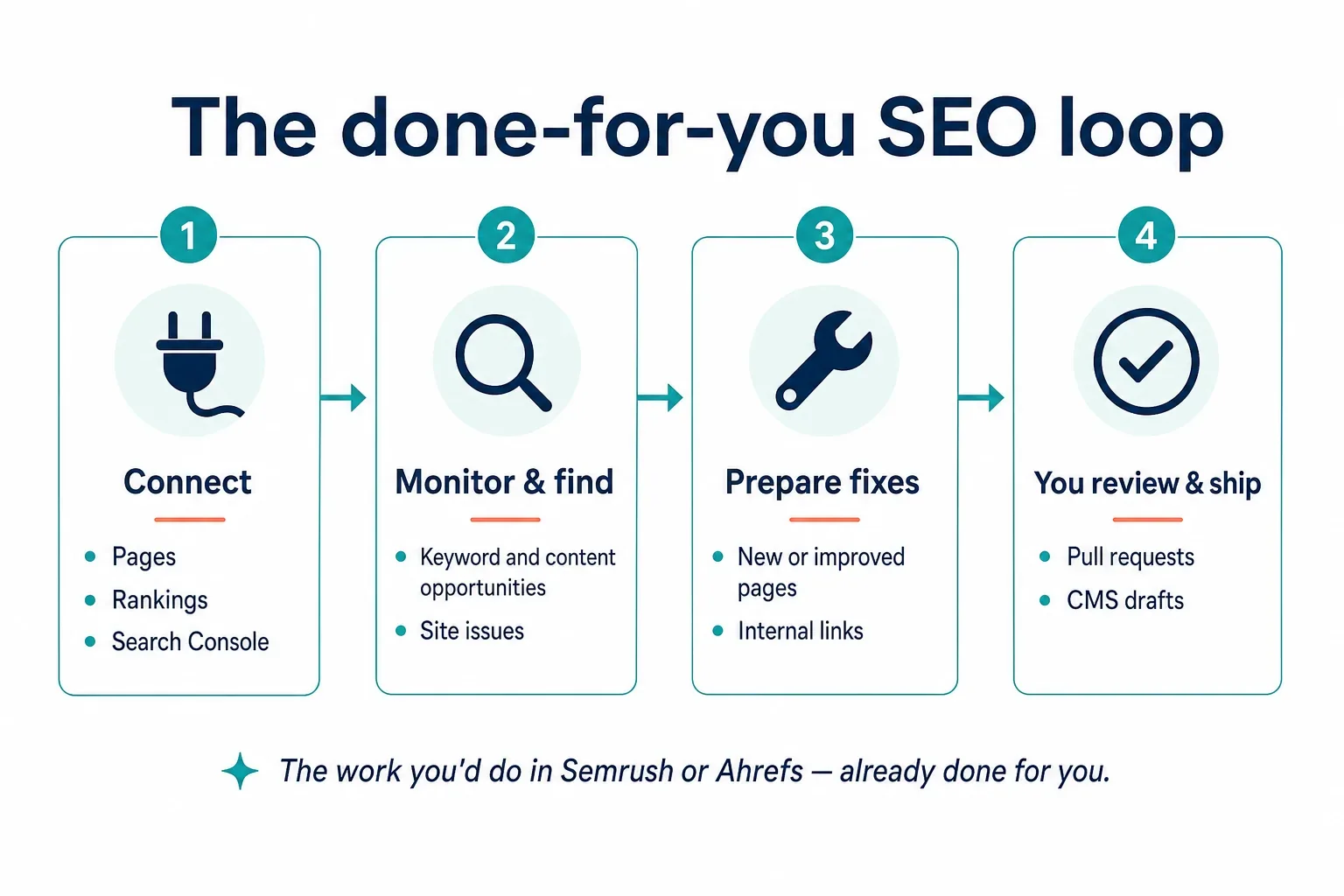
Before the feature-by-feature breakdown, an honest plug that may save you the whole decision. Most people who buy Semrush or Ahrefs use them for a short list of jobs: watch rankings, find keyword and content opportunities, catch site issues, and get fixes shipped. That's also exactly the daily grind both subscriptions assume you'll do yourself.
RomeoSEO handles that loop for you. It connects to your pages, rankings, and Search Console data, watches them every day to decide your next best SEO task, finds keyword and content opportunities, and writes the actual fixes: new articles researched against live Google results, improved pages with internal links, and fixes for content and technical issues. Every draft goes through an editorial review before it is finished, and the work reaches your site as a GitHub pull request, a Webflow or WordPress draft, or a one-click copy. It also checks how ChatGPT, Gemini and Google's AI answers mention your site. In other words, it's the work you'd open Semrush or Ahrefs to do, already done, at roughly half the price of either suite.
It's not a link-index suite: if deep backlink research is your core job, the comparison below still matters. But if your goal is a site that improves every week without you living in a dashboard, start a free trial of RomeoSEO before you commit to a $129-to-$500-per-month analysis subscription.
Semrush: What You Get
Semrush is a broad marketing suite. The SEO side includes keyword research, Position Tracking, Site Audit, backlink data, and content tools, and the same subscription adds marketing features outside pure SEO. Its own pricing page describes plans as bundles you "start with" and "add more as you grow," which tells you the design philosophy: one account, many toolkits, some sold as add-ons.
Ahrefs: What You Get
Ahrefs is built around its backlink index, with Site Explorer, Site Audit, Keywords Explorer, and Rank Tracker grouped in one interface. Its plans are simpler to compare: fewer tiers, a credit-based usage model, and clear limits on tracked keywords and crawl credits printed on the pricing page. If you mostly want link research and rank tracking without a marketing platform attached, that focus is the appeal.
Keyword research
Both tools are strong here, and both publish their own database sizes. Semrush claims the largest keyword database on the market on its rank tracking page; Ahrefs claims billions of keywords too. These are vendor self-reported numbers, not independently measured, so treat them as marketing claims rather than a measurable difference.
Where they feel different in practice:
- Semrush groups keyword tools with content tools, so a keyword idea can flow straight into a content brief on higher plans.
- Ahrefs puts SERP analysis front and center: every keyword report shows the exact pages that rank, which helps you judge difficulty by looking at the competition rather than trusting one difficulty score.
Practitioner discussions, like this long-running Reddit thread on choosing between the two, tend to settle on a familiar split: Ahrefs for link data and interface, Semrush for breadth. Keyword research rarely decides the purchase. For how to act on keyword findings once you have them, our guide to SEO keyword ranking covers tracking and improving rankings from Search Console data.
Site audits and technical SEO
Both suites crawl your site and prioritize issues. The meaningful difference is scale and cost:
- Ahrefs publishes crawl credits per plan on its pricing page: 100,000 crawl credits per month on Lite, 500,000 on Standard, and 1,500,000 on Advanced.
- Semrush includes Site Audit in every SEO plan, with larger page limits on Guru and Business.
If you run one large site, compare the audit limits against your page count before anything else. If you run several smaller sites, plan limits like Semrush's "websites to monitor" (5 on entry plans) matter more. For criteria to judge any analysis tool beyond this pair, see our guide to choosing SEO analysis tools. And if you'd rather have the audit findings fixed for you than exported into a to-do list, that's the gap RomeoSEO closes, as the shortcut section above explains.
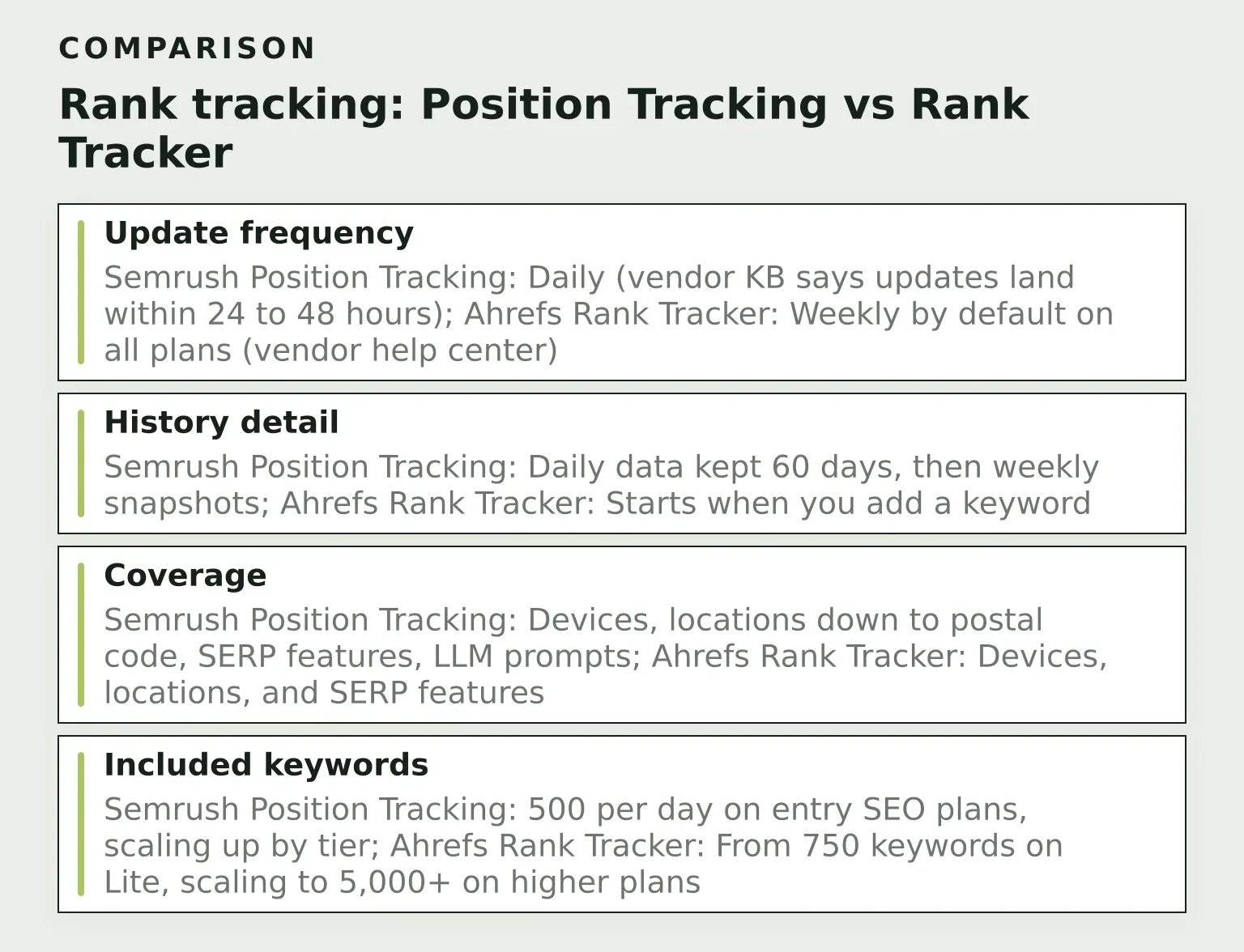
Rank tracking: Position Tracking vs Rank Tracker
This is where the two tools differ in a way you can feel daily.
| Semrush Position Tracking | Ahrefs Rank Tracker | |
|---|---|---|
| Update frequency | Daily (vendor KB says updates land within 24 to 48 hours) | Weekly by default on all plans (vendor help center) |
| History detail | Daily data kept 60 days, then weekly snapshots | Starts when you add a keyword |
| Coverage | Devices, locations down to postal code, SERP features, LLM prompts | Devices, locations, and SERP features |
| Included keywords | 500 per day on entry SEO plans, scaling up by tier | From 750 keywords on Lite, scaling to 5,000+ on higher plans |
Be careful with third-party claims here. Some reviews say Ahrefs Rank Tracker updates daily on paid plans. Ahrefs' own Rank Tracker page and help center both state weekly as the default. If seeing movement every morning matters to your workflow, that single fact may decide this category for you.
AI search visibility
Both vendors now sell AI search tracking, and both price it as a separate layer:
- Semrush offers an AI Visibility Toolkit as a standalone add-on ($99 per month billed annually, per its own pricing page) or bundled into Semrush One plans that start at $199 per month. Entry Semrush One plans include 50 tracked prompts per day.
- Ahrefs includes a small custom prompt quota with paid plans from Lite up (150 checks per month on Lite, per its help center) and sells the full Brand Radar add-on starting at $199 per month per AI platform, or larger custom-prompt packages from $50 per month.
Neither inclusion is generous at entry level, so if AI visibility tracking is a must-have, price the add-on into your total before comparing headline plan prices. Our guide to comparing AI search optimization tools covers the evidence, review, and workflow criteria worth checking beyond the dashboards.
Backlink data
Ahrefs' index is its calling card, and backlink research is the job most practitioners still name first. Semrush's backlink database is large by its own reporting but is generally positioned as one tool among many rather than the core. If competitor link analysis drives your work, this favors Ahrefs. If you only check links occasionally after an audit, both tools will answer your questions, and the difference won't justify the price gap either way.
Semrush vs Ahrefs pricing, by team size
Here are the headline plans from each vendor's own pricing page for Semrush and pricing page for Ahrefs, checked October 2026:
| Plan tier | Semrush (SEO plans) | Ahrefs |
|---|---|---|
| Entry | Pro: $139.95/mo ($117.33 annual) | Starter: $29/mo; Lite: $129/mo |
| Mid | Guru: $249.95/mo ($208.33 annual) | Standard: $249/mo |
| Upper | Business: $499.95/mo ($416.66 annual) | Advanced: $449/mo |
| Enterprise | Custom | $1,499/mo, annual commitment |
| Extra users | Semrush's pricing page lists additional users starting at $45/mo | Lite: up to 2 at $40/mo each; Standard: up to 5 at $60/mo; Advanced: up to 10 at $80/mo |
| AI visibility | AI Visibility Toolkit $99/mo add-on; Semrush One from $199/mo | Brand Radar from $199/mo per platform; prompt packages from $50/mo |
| Free tier | Free Semrush plan with limited reports (vendor KB) | Starter at $29 is the published low entry; check ahrefs.com for current free options |
Worked example for a two-person team: two seats on Semrush Pro means the plan plus one extra seat, starting at roughly $184.95 per month monthly billing. Two users on Ahrefs Lite means Lite plus one additional user at $40, about $169 per month. That gap is small. Add AI visibility tracking and it widens: Semrush's add-on is $99, while Ahrefs' entry prompt tracking starts at $50. Always price the add-ons you will actually use, not just the base plan.
For a fuller look at what to automate versus buy as a suite, see our guide to SEO automation software.
Which tool fits which reader
- Solo practitioner or freelancer: Ahrefs Lite is the cleaner fit. One focused suite, a simple plan ladder, and the lowest realistic entry point for serious backlink work. Pick Semrush Pro instead if you need broad client-facing reporting in one bill.
- Small in-house team (2 to 5 people): run the seat math, not the sticker price. Semrush's entry plan plus cheap extra seats can beat a bigger Semrush tier; Ahrefs Standard bundles more tracked keywords and unlimited credits per user.
- Agency or multi-site operator: Semrush Business's white-label reporting and multi-site monitoring give it the edge for client work. Ahrefs Advanced competes on data limits, but agencies usually need the reporting layer.
- Content-led teams: Semrush's bundled content and optimization tools save a second subscription. If you already have a content workflow, that bundling buys you nothing.
- Owners who want outcomes, not dashboards: whichever suite you pick above, someone still has to turn the reports into shipped fixes. If you'd rather buy the outcome, RomeoSEO does the ranking monitoring, opportunity finding, and the fixes themselves for you, for roughly half the price of either suite.
Where a third option makes sense
As covered in the shortcut section, both tools are analysis suites: they tell you what to fix, while the fixing still takes human hours. Whichever you pick, pairing it with a workflow layer that turns findings into finished changes closes that gap. RomeoSEO works this way: it uses your pages, rankings, and connected Search Console data to find keyword and content opportunities, writes new or improved pages with internal links, and sends the work to your site as a GitHub pull request, a Webflow or WordPress draft, or a one-click copy. It is not a replacement for either suite; it is the step between their reports and your shipped pages, and for many site owners, it covers enough of the day-to-day that the comparison above becomes a much easier call.
Final recommendations
- Pick Ahrefs if backlink research, a focused toolkit, and a simpler plan ladder describe your week. Accept weekly rank-tracking updates by default.
- Pick Semrush if you want keyword research, audits, rank tracking, content tools, and client reporting in one subscription and you'll actually use the breadth.
- Pick RomeoSEO if what you want is the result (rankings monitored, opportunities found, fixes written and sent to your site) without running the workflow yourself. It does the work you'd otherwise do inside Semrush or Ahrefs, at roughly half the price.
- Price both suites with your real seat count and the AI-visibility add-on if you need it. That total, not the headline number, is the honest comparison.
If you want the implementation side handled, start your free trial of RomeoSEO: 3 days free, nothing to pay today.
FAQ
What are the top 3 SEO tools?
For most teams, Semrush and Ahrefs are the two full-suite leaders, and Google Search Console is the essential free third tool everyone should connect. Specialized tools fill gaps, but those three cover research, tracking, and first-party data.
What are the cons of Ahrefs?
The main documented drawbacks: Rank Tracker updates weekly by default rather than daily, useful features like Brand Radar are paid add-ons rather than included, and credits and keyword limits cap how much you can pull per plan.
Is there a cheaper alternative to Semrush and Ahrefs?
If your goal is the daily outcome (rankings watched, issues caught, pages improved), RomeoSEO covers that loop for you at roughly half the price of either suite, by monitoring your rankings and Search Console data and writing the fixes for you. What it doesn't replace is deep backlink-index research, which is Ahrefs' core strength.
Is there anything better than Semrush?
Not broadly, but by job. Ahrefs is stronger for link research, and niche tools beat both suites at narrow tasks like local rank tracking. The better question is which single suite covers the jobs you actually do, which is what this article set out to answer.